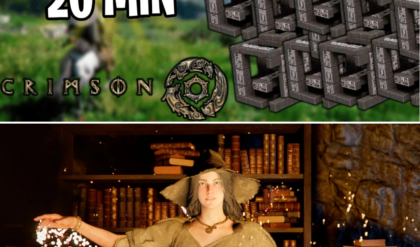
Think grinding high-difficulty bosses is the only way to farm Abyss Artifacts for your skill trees in Crimson Desert? A massive, game-changing strategy has completely bypassed traditional combat progression, yielding up to 10 rare artifacts per run. 🔥
By manipulating a specific “quest state” at night and using a zero-loading-screen fast-travel loop, players are completely breaking the skill point economy. If you aren’t exploiting this exact “pacifist loop” before you finish the Scholastone Institute questline, you are locking your account out of the fastest farm in Pywel. 👇

The mechanical limits of Crimson Desert’s skill-point progression have officially been shattered. Following a series of structural discoveries circulating throughout Reddit, X, and official guild Discord servers, players have unearthed an incredibly lucrative, combat-free loop to farm Abyss Artifacts. The method allows players to amass up to 10 artifacts per cycle, completely invalidating traditional, high-risk end-game boss grinds.
The viral revelation has completely disrupted standard player progression paths. Rather than repeatedly throwing themselves against high-tier encounters like Ader or Gaia to fill their minimap experience bars, players are executing a stealthy “shakedown loop” targeting non-player character (NPC) scholars, allowing them to rapidly max out skill trees for Kliff, Oongka, and Damián.
The Anchorpoint: Propping Open the ‘Halted Research’ Quest
According to highly detailed breakdowns posted across community forums, the structural foundation of this exploit relies on intentionally pausing a specific mid-game questline. Players are issued a strict warning: do not complete the “Halted Research” quest.
To properly set up the farm, players must travel to the prominent Scholastone Institute and initiate their local academic questline, which involves a simple task to purchase tea from a nearby neighborhood. From there, players must advance the subsequent research tracks in a specific chronological sequence:
First Research
Abyss Energy Restoration
Abyssal Energy Research
Stopping exactly at 50% quest progress forces a specific grouping of four distinct scholar NPCs to permanently spawn right next to a physical Abyss Nexus Portal. If the player completes the quest, these scholars disperse across the map, permanently destroying the game’s most efficient localized spawning loop.
Shaking Down the Nexus at Night
The true mechanical efficiency of the farm relies heavily on the game’s internal time cycle. Community testing has confirmed a massive statistical disparity between daytime and nighttime drop matrices:
Daytime Parameters: Yields a conservative 4 to 6 Abyss Artifacts per complete sweep.
Nighttime Parameters (6 PM to 6 AM In-Game Time): Maximizes the internal drop data, allowing players to secure a staggering 7 to 10 Abyss Artifacts per run.
To execute the farm, players must approach the active portal at night, pull out their baseline character Lantern, and scan the physical belts of the waiting scholars. Advanced players are utilizing Damián’s Blinding Flash skill due to its enhanced identification range, though it slightly slows movement animation frames.
The player searches for a distinct square-shaped pouch resting on the scholar’s waist model. Once identified, the player executes a quick-input pickpocket maneuver to extract the Abyss Artifact. If a scholar is positioned awkwardly or sitting directly at a cafeteria table, the community standard is to use a basic physical kick to disrupt their pathing logic before initializing the theft interaction.
The Zero-Loading-Screen Instant Reset
What elevates this strategy from a standard farming route into an un-patchable, hyper-speed efficiency loop is how players are resetting the NPC asset stashes. Traditional farming methods force players to sit through lengthy global loading screens by fast-traveling across different map zones to refresh container inventories.
With this setup, because the pickpocketed scholars are physically standing directly on top of the active Abyss Nexus Platform, the player simply interacts with the nexus under their feet and triggers a fast-travel command to the exact same portal they are currently standing on.
Because the game does not need to load a new geographical landmass, the fast-travel process resolves instantly within two seconds without a loading screen, immediately resetting the scholars’ pickpocket cooldown timers and refreshing their inventories. Players can repeat this loop seamlessly, allowing dedicated completionists to amass over 100 Abyss Artifacts in under two hours of active looting.
Maximizing the Yield: Passive Expeditions
For casual players looking to augment their manual scholar pickpocket loops, veterans are recommending pairing the active Scholastone strategy with passive end-game features. By clearing out the Timeworn Ruins, players can permanently unlock specialized automated dispatch groups.
Sending passive mercenary expeditions into the ruins yields an automated, guaranteed income of 2 to 3 secondary artifacts every few real-time hours, completely independent of active player inputs. Additionally, players can supplement their currency pools by traveling to Hernand City and sweeping the two prominent beggar camps positioned directly to the south and west of the city gates, which feature lower-indexed but highly accessible early-game artifact spawns.
As viral video demonstrations of the instant-reset nexus method continue to accumulate hundreds of thousands of organic views, tension is rising within the community. While Pearl Abyss has aggressively targeted weapon-slot exploits and item duplication bugs in Updates 1.06 and 1.07, the pickpocket loop relies entirely on basic, core game mechanics rather than broken code glitches. Until an official patch note targets scholar item pools, the directive throughout Pywel is absolute: halt your research, wait for nightfall, and clean out the Scholastone Institute.
News

LEADER OF THE PACK: HARDCORE ‘CRIMSON DESERT’ PLAYERS BRAVE INTRICATE GRIND TO UNLOCK PERMANENT ‘SILVER FANG’ WHITE WOLF MOUNT
Tired of riding standard horses across the vast terrains of Pywel? Crimson Desert players have officially unlocked the questline to secure a permanent, massive White Wolf mount that fights by your side—and it completely rewrites world traversal. 🔥 This mythical…

A MILE WIDE, AN INCH DEEP: ‘CRIMSON DESERT’ BASKED IN COMMERCIAL SUCCESS AS PLAYERS RAPIDLY REJECT ‘NONSENSICAL’ MAIN STORYLINE
Think Crimson Desert is a flawless masterpiece? A massive wave of backlash is exposing the game’s biggest structural failure—and players are openly admitting to skipping hours of cutscenes just to escape it. 💣 While the physics-based combat and open-world mechanics…

LOOT MATRIX SHATTERED: ‘CRIMSON DESERT’ PLAYERS EXPLOIT INTENTIONAL DEFENSIVE MECHANIC FOR INFINITE HIGH-TIER ABYSS GEAR
Still bleeding gold and wasting endless hours grinding standard mobs for endgame sockets in Crimson Desert? A revolutionary new exploit at the Icewatch Altar has completely broken the gear progression system, letting you farm an infinite loop of high-tier Abyss…

RIDE IN STYLE: ‘CRIMSON DESERT’ UPDATE 1.06 DROPS SECRET MOUNT UPGRADE SYSTEM TO COMPLETELY ALTER EXOTIC BEAST APPEARANCES
Still riding your legendary and special mounts with their boring, generic default appearances? Crimson Desert’s recent 1.06 patch completely overhauled the stables, quietly adding real, functional upgrade saddles for non-horse mounts. 🔥 From heavily armored bear saddles to high-tech raptor…

THE ULTIMATE UPGRADE: UNANNOUNCED ‘CRIMSON DESERT’ UPDATE ALLOWS KLIFF TO EQUIP EXPERIMENTAL ENDGAME ARMOR SET
Think you’ve unlocked Kliff’s ultimate endgame look? A massive, undocumented change in the latest updates has quietly enabled Kliff to equip an armor set that was previously restricted, completely rewriting the heavy armor meta overnight. 🔥 The legendary Belkandor Plate…

THE PYWEL CENSUS: ‘CRIMSON DESERT’ LANDSCAPE RANKED FROM WORST TO BEST AS SLEEPER REGION CRUSHES EXPECTATIONS
Think your favorite region in Crimson Desert is the absolute gold standard of open-world design? A massive tier-list breakdown ranking all 5 main regions of Pywel has completely split the player base down the middle. 🔥 From lush starting fields…
End of content
No more pages to load