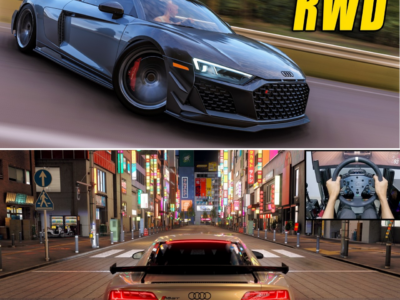
SHATTERING THE META: THE DRIVETRAIN CIVIL WAR DIVIDING FORZA HORIZON 6 PLAYERS
The meta is shattered. For over a decade, Forza players blindly relied on a single drivetrain swap to dominate every leaderboard, but Forza Horizon 6 just re-engineered its core tire physics to trigger an absolute tactical civil war!
Purists are aggressively locking horns with casual power-sliders over an illegal 1000-horsepower handling plateau, but are your favorite AWD builds secretly robbing you of the highest corner speeds on the streets of Tokyo?
From high-stakes half-mile drag races to specialized “throttle lift oversteer” time attacks, the grid has never been this divided—get the unedited drivetrain breakdown, meta tier lists, and hidden tuning setups below! 👇🔥
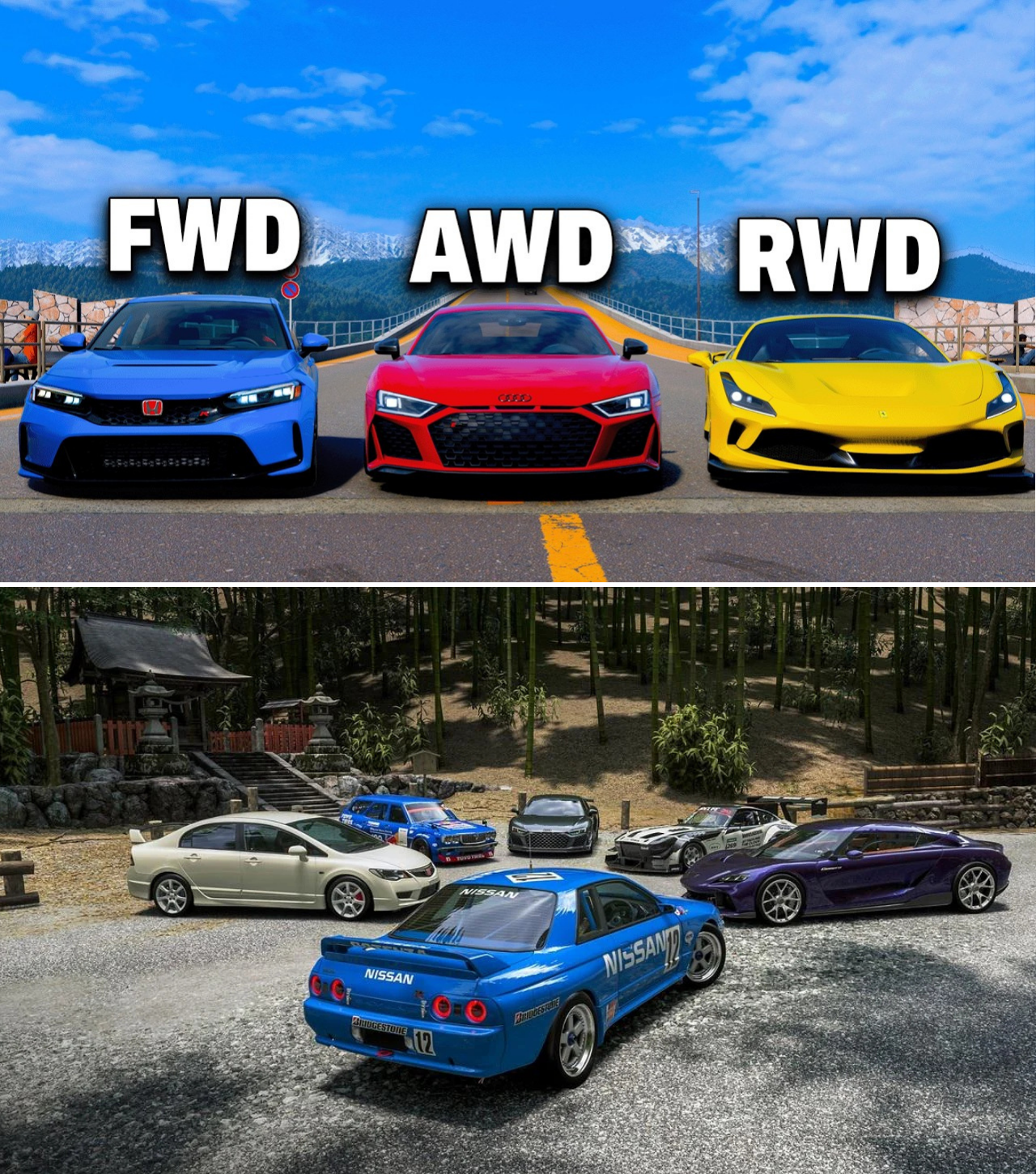
The ultimate automotive debate has officially hit the virtual streets of Japan. For generations of digital racing enthusiasts, the mathematical blueprint for dominating Microsoft’s flagship racing franchise was shockingly simple: when in doubt, execute an All-Wheel Drive (AWD) drivetrain swap. However, with the launch of Forza Horizon 6, Playground Games has significantly re-calibrated its underlying physics and tire telemetry engine, sparking an intense ideological and tactical civil war across Reddit, Discord, and X (formerly Twitter).
A comprehensive mechanical analysis published by prominent racing authority MitchCactus has brought the systemic friction into sharp focus. The detailed investigation pits traditional AWD configurations against Rear-Wheel Drive (RWD) purism and highly specialized Front-Wheel Drive (FWD) time attack mechanics. As players grind through their seasonal festival wristbands, the data reveals that while one drivetrain still rules the off-road dirt maps with an iron fist, the high-performance road racing meta has fractured into a complex, skill-dependent hierarchy.
The All-Wheel Drive Hegemony: Consistency vs. The “Power Sliding” Debate
Historically, AWD configurations have acted as the primary safety net for the Forza player base. The fundamental mechanical advantage remains undisputed: unparalleled acceleration from a dead standstill and a massive traction claw when exiting low-speed corner apexes [01:06]. In a live-service multi-player ecosystem where online lobbies are frequently chaotic, the ability to recover instantly from a collision or an over-shot braking zone makes AWD the default choice for mainstream competitive events, particularly as vehicles scale into the high-velocity S2, R, and X-Class brackets [01:28].
Furthermore, the game’s environmental design fundamentally dictates drivetrain logic when leaving the tarmac. For disciplines such as Dirt Racing, Rally, and Cross Country, the community maintains that an AWD setup is a non-negotiable parameter [00:47]. The loose-surface tire slip modeling introduced in Forza Horizon 6 heavily punishes single-axle propulsion when navigating severe vertical elevation changes or unpredictable mud banks [00:54].
However, this mechanical dominance has drawn fierce criticism from the franchise’s self-proclaimed “purist” circles, particularly within the drifting subculture. High-tier drift clubs actively dismiss AWD drift configurations, labeling the style as synthetic “power sliding” rather than authentic drifting [01:56]. While an AWD setup allows casual players to effortlessly lock in three-star scores on localized drift zones without fear of spinning out, it lacks the technical finesse demanded by the competitive elite [02:11].
The Rear-Wheel Drive Uprising: The 1,000-HP Performance Plateau
In a deliberate move to appease car enthusiasts, Forza Horizon 6 has injected significant viability back into RWD platforms. The system’s physics update rewards drivers with substantially higher mid-corner speeds and realistic tire grip thresholds compared to their bulkier AWD counterparts—provided the operator can manage the throttle [04:12]. This balancing patch is explicitly visible on the global Rivals Leaderboards, where the fastest legitimate, un-hacked telemetry times in the C-Class up to the S1-Class are heavily dominated by specialized RWD tunes [04:23].
The RWD ecosystem represents the true “purist” approach, where players deliberately preserve a vehicle’s factory blueprint—such as classic JDM sports cars—rather than executing immersion-breaking V12 or AWD swaps [03:23]. This authentic configuration is mandatory within the game’s Formula Drift roster, which serves as the foundational training ground for advanced steering-angle management [03:57].
However, RWD operators face a brutal mechanical barrier known across community forums as the “Handling Plateau.” Once a rear-wheel build crosses the threshold of 1,000 horsepower, the rear tires experience extreme, sustained fish-tailing under acceleration [04:59]. For the average driver, managing a thousand horses on a rear-axle layout requires surgical throttle control, forcing many to capitulate and opt for an AWD conversion.
Yet, for the top echelon of skilled racers, the reward is unmatched straight-line velocity. In high-stakes half-mile drag racing stretches, RWD builds consistently chase down AWD off-the-line launchers due to their superior top-end weight distribution. Iconic speed relics like the Toyota Sprinter Trueno Forza Edition and the Hennessey Venom F5 leverage pure RWD telemetry to shatter the mythical 300 mph barrier [02:44].
Front-Wheel Drive and the Time Attack Phenomenon
Perhaps the most surprising evolution in Forza Horizon 6’s meta is the emergence of highly specialized FWD competitive niches. Traditionally mocked as uncompetitive and entirely irrelevant in high-tier multi-player series, FWD remains heavily constrained by severe power understeer when the driver is actively pinned to the throttle [05:53].
To counter this factory deficiency, advanced tuners have engineered a specialized technique called Throttle Lift Oversteer [05:53]. By precisely easing off the accelerator right before committing to a hard turn, drivers can deliberately induce a controlled rear-end slide, allowing lightweight cars to snap sharply through tight apex corners.
This mechanical phenomenon has found a natural home within localized Time Attack events. Forza Horizon 6 has introduced dedicated Time Attack brackets featuring vehicles like the Honda Civic 101 Motorsport edition [07:09]. While these front-wheel-drive pocket rockets dominate tight, technical micro-circuits due to severe weight reduction, their utility rapidly disintegrates on sprawling road racing maps where low top-speed ceilings and persistent understeer leave them entirely outmatched by standard multi-platform builds. When contrasted with an AWD Time Attack titan like the Lotus 3-Eleven Motorsports edition, the FWD alternative demands twice the physical driver effort for a lower overall velocity yield [07:24].
The Festival Verdict
As Playground Games prepares its upcoming seasonal festival balancing patches, the tactical consensus among elite driving clubs emphasizes mechanical hybridity. Relying entirely on a single drivetrain layout restricts a player’s ability to maximize their garage across Forza Horizon 6‘s dense Japanese topography.
For beginners seeking to claim their initial festival wristbands and secure guaranteed multi-player podiums, the un-nerfed stability of All-Wheel Drive remains the undisputed king of the sandbox. However, as virtual drivers master throttle dead-zones and transition into the hardcore Rivals tiers, shedding the front drive shaft in favor of a high-downforce RWD configuration remains the only authentic way to touch the absolute limit of digital speed.