🚨 NVIDIA JUST CROSSED THE LINE? PC GAMERS ARE IN AN ABSOLUTE UPROAR! 🚨
“This isn’t gaming anymore.” “The death of art.” “I didn’t pay $2,000 for an AI filter.” 🖥️❌
NVIDIA just unveiled DLSS 5 at GTC 2026, and instead of just boosting frames, they’re doing something so radical it’s being called the “End of Human Artistry” in video games. We’re talking about “Neural Rendering” that doesn’t just upscale—it literally replaces the game’s lighting and textures with AI-generated “photorealism.” 🤯
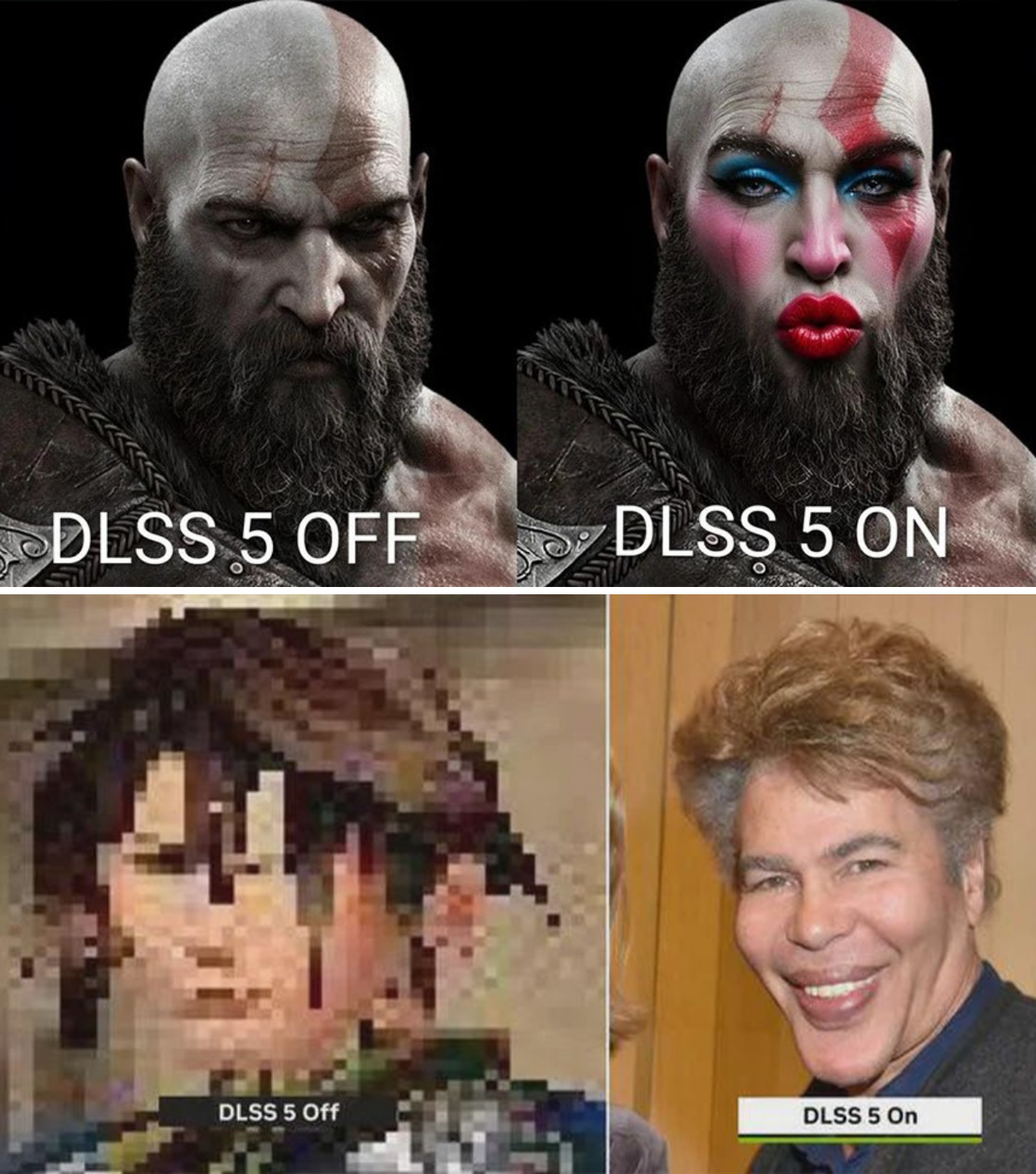
The tech demos for Starfield and Resident Evil Requiem look stunning at first glance, but when you look closer, something is very wrong. Character faces are being “beautified” into unrecognizable AI clones, and the original artistic vision of the developers is being smothered by what critics are calling “AI Slop.” 🎨⚠️
Is NVIDIA finally pushing too much “fake” into our games? Or is this the “GPT moment” for graphics that we’ve been waiting for? One specific detail in the FAQ about “Dual-GPU requirements” for the preview has the community’s blood boiling. 😡
See the “uncanny” comparison shots and find out why the top comments are almost 100% negative below! 👇🔥
NVIDIA CEO Jensen Huang stood before a crowded keynote hall at GTC 2026 yesterday and declared that “the future of graphics is neural.” But for a massive segment of the PC gaming community, that future looks less like a breakthrough and more like a “hostile takeover” of digital art.
The unveiling of DLSS 5 (Deep Learning Super Sampling 5) has sparked what may be the most intense backlash in the company’s history. Unlike previous iterations focused on resolution upscaling (DLSS 2) or frame interpolation (DLSS 3), DLSS 5 introduces “Real-Time Neural Rendering”—a technology that essentially layers a generative AI “filter” over a game’s lighting, materials, and character models to achieve photorealism.
Within hours of the announcement, social media platforms were flooded with accusations of “AI Slop,” a derogatory term used to describe the glossy, generic, and often “soulless” aesthetic associated with generative AI tools.
The ‘Yassification’ of Gaming
The core of the outrage stems from NVIDIA’s own tech demos. In side-by-side comparisons of Resident Evil Requiem and Starfield, DLSS 5 transformed low-fidelity character faces into hyper-realistic portraits with individual pores, realistic subsurface scattering, and complex micro-expressions.
However, critics were quick to point out that the AI-enhanced characters often looked nothing like the original designs. On Reddit’s r/pcmasterrace, a trending post titled “DLSS 5: Finally, a technology that renders exactly what the developers didn’t intend” garnered over 20,000 upvotes in under six hours.
“It looks like an Instagram filter for games,” wrote one top commenter on TechPowerUp. “The AI is ‘correcting’ the artist’s work. If I’m playing a horror game, I want the gritty, stylized lighting the director intended, not a sanitized, hyper-sharp AI reconstruction that makes everything look like a stock photo.”
Neural Rendering: Breakthrough or Crutch?
NVIDIA frames DLSS 5 as a necessity. As silicon scaling slows and raw rasterization performance hits a plateau, the company argues that AI is the only path forward for a “million-fold” increase in visual fidelity.
“DLSS 5 is the GPT moment for graphics,” Jensen Huang stated during the keynote. “It bridges the divide between rendering and reality.”
But the technical cost is already raising eyebrows. While NVIDIA promises the final release this fall will run on a single GPU, the early previews at GTC required two GeForce RTX 5090s to function in real-time. This has led to fears that developers will use DLSS 5 as a “crutch” to avoid optimizing their games, forcing players to rely on expensive hardware and AI “hallucinations” to achieve playable frame rates and decent visuals.
The ‘Uncanny Valley’ Reaches a Peak
The reaction on YouTube has been overwhelmingly negative. Tech outlets like Digital Foundry and Windows Central noted that while environmental lighting in DLSS 5 is “astonishing,” the human elements fall deep into the uncanny valley.
In the Starfield demo, the AI-generated lighting reportedly changed the “vibe” of the game’s opening so drastically that it felt like a different title entirely. “Immersion is about making the world feel real, not making it look like an AI-generated video,” argued Michael Hoglund of Windows Central.
For many, the “soul” of a game lies in its imperfections and artistic choices. By allowing an AI model—trained on billions of real-world images—to “re-interpret” those choices in real-time, NVIDIA is entering a philosophical minefield regarding authorial intent.
Developer Support vs. Fan Boycott
Despite the community’s vitriol, industry giants are lining up. Bethesda, Capcom, Ubisoft, and Tencent have already pledged support for DLSS 5 in their upcoming 2026 and 2027 titles. These developers argue that the technology allows them to achieve “Hollywood-grade” visual effects that would be impossible with traditional rendering.
However, the “No Fake Frames” crowd from the DLSS 3 era has found new life in the “No Fake Pixels” movement. A change.org petition titled “Keep AI Out of Game Rendering” has already gained 50,000 signatures.
“We are reaching a point where the game you see on your screen isn’t the game the developers made,” said a prominent PC gaming YouTuber. “It’s a probabilistic guess made by a black-box algorithm. If we accept this, we’re saying goodbye to art direction.”
What’s Next?
NVIDIA is targeting a Fall 2026 launch for DLSS 5, likely coinciding with the full rollout of the RTX 50-series “Vera Rubin” architecture. Between now and then, the company faces a monumental PR challenge: convincing a skeptical audience that AI-infused pixels aren’t just “slop,” but the next evolution of the medium.
As the debate rages on, one thing is certain: the line between “rendered” and “generated” has never been blurrier. Whether gamers will embrace this “brave new world” or stick to their “soulful” native pixels will be the defining story of the 2026 holiday season.
News

Behind the Mask: The Rigorous, Secret Reality of Filming ‘Off-Campus’
Think your favorite ‘Off-Campus’ moments were all acting? Think again. 🏒🔥 The behind-the-scenes reality of Brier University is way more intense than what you’re seeing on screen. From secret auditions that ended in tears to a mandatory hockey boot camp…

The Architecture of Perfection: Mastering the Horadric Cube for Endgame Footwear
STOP WASTING GOLD! The 100% Guaranteed “Godly Boots” Crafting Method! 👟💎 Tired of bricking your best gear at the Occultist? The Horadric Cube has officially changed the game. Forget “RNG” – players have perfected a step-by-step crafting loop to create…

The 4,269 Trillion Damage Threshold: How the “Top Ladder” Druid is Redefining Season 13
4,269 TRILLION DAMAGE: The Druid Build That Broke the Leaderboards! 🤯🔥 Forget everything you know about “Meta” Druid builds. A new setup has officially shattered the damage ceiling, hitting an absurd 4.269 Trillion damage per hit! This isn’t just a…

Hurricane of the Ursine: Decoding the Bearnado Build’s Rise to Pit 125+
THE “BEARNADO” IS REAL: This Druid Build Just Shredded Pit 125+! 🌪️🐻 Think the Druid was dead in Season 13? Think again. The “Bearnado” build has officially arrived, and it’s arguably the most insane, tanky, and high-damage setup the class…

The Scosglen Gold Rush: How “Root Farming” is Resetting the Diablo 4 Economy Byline: Staff Reporter
BROKEN FARMING META: Get Infinite “Giga Weapons” & Materials in Seconds! ⚔️🔥 Stop wasting your time on slow boss grinds. A new “Root Farming” meta has been discovered in Diablo 4: Lord of Hatred that allows you to flood your…
The Infinite Mythic Loop: Anatomy of Season 13’s Most Damaging Exploit Byline: Staff Reporter
BROKEN! Infinite Mythics Are Now Possible—But Hurry! 🚨✨ Stop farming bosses the “intended” way. A new, game-breaking glitch has surfaced in Diablo 4: Lord of Hatred that allows you to farm Mythic Uniques infinitely in a single session. While the…
End of content
No more pages to load