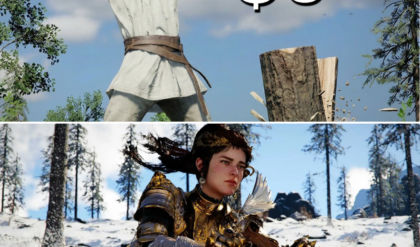
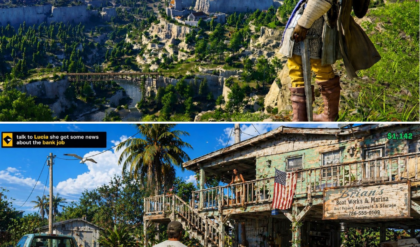
I stripped my character of all legendary gear and tried to live as a literal nobody in Crimson Desert… It didn’t go well. 💀
What happens when you completely ignore the main story, unequip your weapons, and try to live a 100% normal, peaceful life as a common peasant in Pywel? Hardcore players are conducting a bizarre social experiment to see if Pearl Abyss actually built a functional medieval life simulator—or just a giant tech demo. From picking apples by hand to hunting down actual day jobs and managing a dynamic local economy, the dark truth about trying to survive a “9-to-5” in this brutal open world is blowing up on YouTube and Reddit. If you think the game is only about flashy combat and legendary boss builds, you are completely missing the most unhinged underlying system.
Is it actually feasible to build a cozy, normal life here, or does the world actively force you back into a life of crime and violence? 👇

Can you survive a fantasy epic if you refuse to be the hero? That is the bizarre question currently dividing the Crimson Desert community. As veterans hit the 200-hour mark and face the standard “post-game void,” an unhinged new gaming trend has completely hijacked Reddit, Discord, and YouTube. Led by prominent content creators like Arean, players are actively stripping their characters of legendary weapons, abandoning the Greymane mercenary narrative entirely, and attempting to live a peaceful, mundane “9-to-5” life as an ordinary peasant. The viral social experiment has exposed a staggering, highly detailed layer of underlying mechanics within Pearl Abyss’s BlackSpace Engine—but it has also revealed that trying to earn an honest, non-violent living in Pywel is an absolute nightmare.
Punching In: The High-Stakes Hunt for Medieval Day Jobs
For years, AAA open-world titles have treated town centers as mere background decoration—vibrant but hollow stages where static NPCs mimic life. Crimson Desert, however, has quietly implemented an intricate life-simulation architecture that allows players to physically interact with the mundane economy.
In viral deep-dives circulating the community this week, players attempting the “peasant run” are entirely ignoring combat mechanics to explore the manual labor market. The BlackSpace Engine allows for radical environmental interaction: players can operate massive industrial cranes, climb trees to physically harvest apples, and take on localized manual requests from town merchants. From checking the honey quality at the Polandarth Apiary to managing livestock, the game features a surprising roster of blue-collar labor.
However, the community is quickly discovering that the economic balancing act is brutally realistic. Hardcore threads on the game’s official Subreddit have begun calculating the exact payouts of these peasant jobs, debating which manual tasks pay the best wages and whether a player can realistically afford food, shelter, and basic clothing solely through honest, non-violent town labor. Early data indicates that without the massive financial windfalls of high-tier bounty hunting or boss rematches, the daily grind of a common laborer in major capitals like Hernand is an exhausting, low-yield struggle.
The Arcade Combat vs. Cozy Life-Sim Divide
The sudden obsession with treating Crimson Desert like a medieval The Sims or Stardew Valley has amplified a massive structural debate within the fanbase. On one side of the aisle, casual gamers find the deep interactive systems incredibly relaxing.
“The open world is beautifully interactive, which makes it hyper-immersive,” one prominent veteran noted on a massive Reddit thread comparing the game to Elden Ring. “Sometimes after work, just slow-riding around, cooking crafted meals, and interacting with the minor systems feels amazing.”
Yet, this intense level of detail has drawn fierce criticism from the hardcore, action-oriented crowd. Critics argue that Pearl Abyss has created a clashing, disjointed identity that tries to do far too much at once. Hardcore players complain that the combat lacks the meticulous precision of a FromSoftware title because the survival elements allow for “unlimited heals” via easily crafted food items and infinite revives through cooked pills.
“The game doesn’t know what it wants to be,” a skeptical reviewer wrote on Steam. “It’s a generic medieval setting mixed with steampunk influences, flying machines, and drones, wrapped around a crafting and farming simulator. It feels like an amalgamation of default textures and a tech demo rather than a cohesive game.”
The Post-Game Void and the Push for Systemic Upgrades
The phenomenon of players forcing themselves to live like peasants highlights a much deeper issue plaguing Crimson Desert‘s end-game loop: the static nature of the world once the main chapters conclude. Hardcore communities have officially petitioned the lead systems designers and community managers at Pearl Abyss to bridge the gap between high-level combat and the game’s deep life-simulation mechanics.
A consolidated, highly researched breakdown of solutions currently trending on Steam suggests that Pearl Abyss needs to utilize the BlackSpace Engine to create a dynamic, systemic post-game. Proponents argue that instead of generic quests, the developers should introduce a logic-based, procedural faction system.
“Allow us to endlessly invest our hard-earned peasant and mercenary resources into fortifying our own camps or capturing ruined castles across Pywel,” a popular community thread reads. “Give rival factions the ability to dynamically launch siege events against our territory, forcing us to defend our farms and investments alongside our companions.”
Is a True ‘Normal Life’ Sustainable in Pywel?
Ultimately, the “Peasant Simulator” trend has proven that while Pearl Abyss has built one of the most interactive open-world environments in modern gaming history, the ecosystem is fundamentally engineered for conflict. Players attempting to live a quiet life are consistently pulled back into the chaotic gravity of Pywel’s political and monstrous dangers. If a player ventures too far out of town to harvest resources or move goods along the Salt Road, they are instantly met with hyper-aggressive bandits or terrifying world bosses that require deep mastery of character swaps and advanced combo mechanics to survive.
Furthermore, console players on PlayStation 5 have noted that the game’s intense performance overhead often breaks the peaceful immersion during large-scale town gatherings or when managing fully-developed camps, reminding players of the hardware limitations backing this massive simulation.
Looking to the Horizon
As the internet remains fixated on these bizarre lifestyle experiments within Crimson Desert, the ball is firmly in Pearl Abyss’s court. The community has made it abundantly clear that they are deeply enamored by the game’s weird, non-combat systems.
Whether the developers will leaning heavily into these life-sim elements in an upcoming DLC—adding robust housing, an expanded local merchant economy, and deeper non-violent career paths—remains the major question. For now, players will continue to drop their swords, pick up apple baskets, and test the absolute limits of what it means to live a normal life in a world built for war.
News
MOVING OVER, ROCKSTAR: How ‘Crimson Desert’ Quietly Stole GTA 6’s Open-World Thunder and Rekindled a Broken Gaming Genre
GTA 6 is officially in serious trouble, and the killer came from the most unexpected studio in Asia… 💣 While Rockstar Games keeps drip-feeding trailers, a massive gaming revolution has quietly taken over the internet. Hardcore open-world fans are completely…

CRIMSON DESERT CHAOS: Patch 1.07 Drops Days After Last Update as Game-Breaking Character Buffs and ‘Censorship’ Armor Controversies Divide Fans
Is Pearl Abyss secretly breaking its own game just days after the last patch? 🚨 The community is losing its absolute minds over Crimson Desert Patch 1.07, and it’s not just about the stealth fixes. Damian just received a completely…

EARTHQUAKE IN SANCTUARY: ‘Stone Burst’ Druid Emerges as the Unexpected King of Pit 130+ Pushing
DRUIDS ARE FINALLY S-TIER! 🐻💥 (PIT 130+ MADE EASY) If you thought the Warlock was the only class breaking the game in Season 13, you haven’t seen the Stone Burst Druid in action. We’re talking about “Trillion-damage” explosions that turn…

CRAFTING CHAOS: How the Horadric Cube’s ‘Hidden’ Amulet Recipes are Breaking the Diablo 4 Meta
STOP VENDORING BLUES! YOU’RE TRASHING GODLY AMULETS! 😱💎 Did you know a “Magic” blue amulet could actually be the base for the most broken item in your build? The Horadric Cube in Season 13 has officially changed the crafting game,…
HEAVENLY WRATH: ‘WingStrike’ Paladin Build Ascends to S-Tier as Players Delete Torment 12 Content
PALADINS ARE FINALLY BROKEN! 🕊️🔥 (PIT 100+ IN SECONDS) Everyone thought the Sorcerer would dominate the Skovos Isles, but the WingStrike Paladin just walked in and deleted Torment 12 like it was a tutorial. This isn’t just a build; it’s…
THE RICH GET RICHER: Pro Players Reveal ‘Infinite Mythic’ Loophole in Diablo 4: Lord of Hatred
STOP GRINDING BLINDLY! THE ULTIMATE MYTHIC LOOP IS HERE 💎🌀 Are you still running bosses one by one? You’re doing it wrong. The “Lord of Hatred” endgame is all about the Undercity + War Plans synergy, and we just found…
End of content
No more pages to load