Imagine bleeding for days with NO pads, NO tampons, NO painkillers… and still expected to dance at balls, smile through teas, and pretend everything’s perfect. 😱🩸
In the Bridgerton era, ‘courses’ or ‘flowers’ were a dirty secret women hid at all costs. No modern products existed — just rags, clouts, homemade belts that chafed like hell, primitive suppositories on sticks (yes, really), and constant fear of leaks staining those pristine white gowns. Heavy flow? Extra petticoats or just… free-bleed into your skirts. Cramps? Herbal teas if you were lucky, or suffer in silence because pain was ‘natural.’
Daphne’s quiet devastation in Season 1 when her menses arrived at the opera? That’s the tip of the iceberg. Most women wouldn’t survive a week in that suffocating reality without breaking.
Season 4 Part 2 dives deeper into women’s hidden struggles — Sophie’s hardships as a maid make it even rawer. This isn’t just romance; it’s a brutal look at what Regency ladies endured every month.
You won’t believe how grim (and ingenious) it really was. 👇 Prepare to be shocked. 🔥🩸
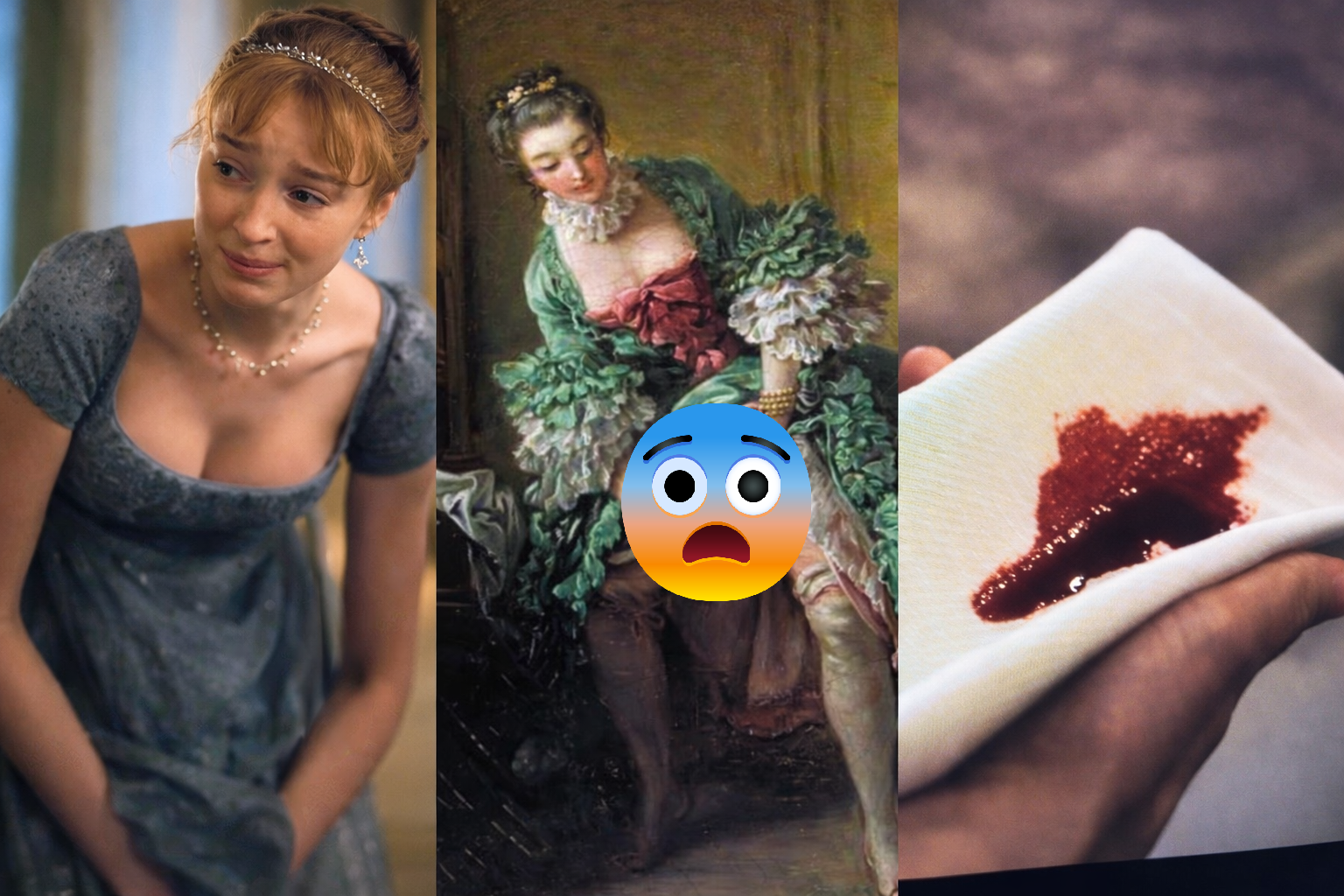
Netflix’s “Bridgerton” has captivated audiences with its lavish balls, steamy romances, and glittering Regency-era glamour, but one aspect rarely shown on screen is the gritty reality of menstruation for women in the early 1800s. A viral video titled “How Menstruation Worked in the Bridgerton Era” has sparked widespread discussion, with fans declaring the era’s methods so uncomfortable and unhygienic that “most of us wouldn’t survive that.” As Season 4 Part 2 approaches on February 26, the topic adds another layer to the show’s exploration of women’s hidden burdens amid societal expectations.
In the Regency period (roughly 1811–1820, with the show’s timeline extending slightly later), menstruation was shrouded in secrecy and euphemism. Polite society avoided direct terms like “period” or “menstruation,” opting instead for phrases such as “courses,” “flowers,” “monthly illness,” or simply “being unwell.” Medical texts used clinical language, but in conversation, it was taboo — a reflection of broader attitudes toward women’s bodies as private and potentially shameful.
The show subtly nods to this in Season 1, when Daphne Bridgerton (Phoebe Dynevor) checks her undergarments in distress upon realizing her menses have arrived during an opera outing. The moment underscores the pressure: even in high society, a visible stain could spark scandal, ruining a debutante’s prospects. No commercial sanitary products existed — disposable pads wouldn’t arrive until the late 19th century, and tampons much later. Women relied on homemade solutions that were labor-intensive, unreliable, and often painful.
Historical accounts from the Georgian and Regency eras describe the most common method: reusable cloth “rags” or “clouts.” These were folded pieces of linen, cotton, muslin, or flannel placed between the legs or secured to undergarments. Wealthier women might use finer, absorbent fabrics stitched into pads, while poorer ones made do with scraps of old clothing. The phrase “on the rag” — still in use today — originates from this practice. For heavy flows, women layered multiple cloths, wrapped a belt or bandage around their hips, and looped a muslin napkin or “loincloth” over front and back, sometimes lined with additional stitched pads that could be boiled and reused.
Without modern underwear — women’s “drawers” were often crotchless or split for practicality — keeping everything in place was challenging. Pins, strings, or ribbons held cloths secure, but movement during dances, rides, or daily activities risked shifting, chafing, or leakage. Chafing was common, especially on thighs, and could lead to irritation or infection in an era before antibiotics. Some women added extra petticoats as backup layers, essentially allowing controlled free-bleeding into skirts if needed. Others reportedly free-bled entirely, relying on dark fabrics or accepting stains as inevitable.
Early prototypes of internal protection existed, though rare and rudimentary. Handbooks mentioned “suppositories for the privy place” — smoothed sticks wrapped in absorbent linen rags, stitched securely with a long cord for removal. These functioned as primitive tampons, sometimes disposable or boiled for reuse. They were not widespread, likely used by women seeking discretion during social events.
Hygiene posed major hurdles. Pads and rags required soaking, washing, and drying — tasks often handled by servants in upper-class homes but burdensome for working women. Boiling helped sanitize, but in an age of limited clean water and harsh soaps, odors and stains lingered. Full-body bathing occurred infrequently (once a week or less for many), so managing blood discreetly was essential to avoid social embarrassment.
Pain management was equally limited. Menstrual cramps were viewed as natural or even a “punishment,” with little sympathy or effective relief. Herbal teas — chamomile, raspberry leaf, or pennyroyal (risky and sometimes abortifacient) — offered mild comfort. Opium-based remedies appeared in some households, but access varied. Bloodletting or restrictive diets were occasionally prescribed by physicians following humoral theory, which saw menstruation as an imbalance needing correction.
Class played a huge role. Upper-class women like the Bridgertons or Featheringtons had servants to handle laundry and could afford better fabrics, affording more privacy. Working women — maids like Sophie Baek in Season 4 — faced harsher conditions, managing cycles while performing physical labor in restrictive clothing. Sophie’s storyline as an illegitimate, mistreated servant highlights intersecting vulnerabilities: class, gender, and bodily autonomy in a rigid society.
The show’s creators have leaned into fantasy escapism, glossing over such realities to focus on romance and drama. Yet subtle inclusions — like Daphne’s moment or broader themes of women’s constraints — resonate with viewers drawing parallels to modern period stigma. Fan discussions on platforms like Reddit and TikTok praise the viral breakdowns for exposing the era’s hardships, contrasting the on-screen perfection with historical grit.
Historians note that while “Bridgerton” takes liberties (multiracial aristocracy, anachronistic fashion), it captures emotional truths: the isolation of women’s health issues in a male-dominated world. Pregnancy and childbirth carried far greater risks, but even routine menstruation reinforced dependence — no quick fixes, constant vigilance, and societal pressure to appear flawless.
As Season 4 Part 2 teases more intimate character moments, including Benedict and Sophie’s evolving romance, the backdrop of Regency womanhood adds depth. Sophie, enduring hardship as a maid, embodies resilience amid systemic barriers — including the monthly ordeal that upper-class ladies managed with privilege but no real ease.
For today’s audience accustomed to pads, tampons, menstrual cups, pain relievers, and open conversations, the era’s methods seem barbaric. Leaks during a waltz? Chafing under corsets? Washing blood-soaked rags by hand? Many fans agree: “Most of us wouldn’t survive that.”
Yet women did — ingeniously, stoically, and often invisibly. “Bridgerton” may romanticize the ton, but peeling back the layers reveals a world where even the most basic bodily function demanded endurance and secrecy. In an era of empire-waist gowns and grand declarations, the real drama was surviving the month.
News

THE ‘KEGSBREATH’ CHRONICLES: Inside the SNL Cold Open That Broke the Internet
STOP SCROLLING: SNL just went nuclear and the internet is losing its mind! 🤯 Colin Jost didn’t just cross the line; he did a kegstand over it while the world watched in stunned silence. If you thought the “Secretary of…

POWER, PRIVILEGE, AND PAIN: WHY ‘MAXTON HALL’ SEASON 3 IS THE ULTIMATE TEST FOR RUBY AND JAMES
THE BELL-BEAUFORT DYNASTY IS CRUMBLING! 🏰 The Maxton Hall Season 3 “Official Trailer” just dropped and it’s pure emotional warfare! Ruby and James thought they survived the worst, but the “Official” look at Season 2’s aftermath just revealed a secret…

SIRENS OF RAYBURN: HOW ‘ZOMBIES 5’ IS REINVENTING THE DISNEY MUSICAL FORMULA
SOMETHING IS IN THE WATER! 🧜♀️ The Zombies 5 “Mermaids” Teaser just dropped and Rayburn will never be the same! Forget the woods, the real danger is coming from the deep! The “First Look” at Zombies 5: Secrets of the…

BEYOND THE WEDDING: ‘VIRGIN RIVER’ SEASON 8 AND THE SHOCKING REVELATIONS THREATENING THE TOWN’S PEACE
THE SECRET MEL AND JACK NEVER SAW COMING! 🌸 The Virgin River Season 8 “First Look” just changed the game forever! Is the peaceful life in the Redwood Forest about to be shattered? After the emotional rollercoaster of the wedding,…

BEYOND GRIEF: ‘THE MADISON’ SEASON 2 REVEALS A DARKER SIDE OF THE MONTANA SKYLINE
NEW YORK LUXURY MEETS MONTANA GRIT! 🏔️ The Madison Season 2 trailer just dropped, and the Clyburn family’s “healing journey” just took a deadly turn! Wait… did we just see a ghost? The Season 2 teaser for Taylor Sheridan’s “The…

A TIME-TRAVELING TURMOIL: HOW ‘BLOOD OF MY BLOOD’ SEASON 2 IS REWRITING THE OUTLANDER GENEALOGY
THE STONES HAVE SPOKEN! 🪨 The Blood of My Blood Season 2 trailer just shattered every fan theory in the Outlander universe! Wait… did the gemstones just fail at the worst possible moment? The Season 1 cliffhanger left Henry and…
End of content
No more pages to load