IS “RUNIC WARD” THE LIFE-SAVER OR A TRAP? 🛡️
The Path of Exile 2 endgame meta is shifting, and the newly revealed Runic Ward mechanic is at the center of a heated controversy. For months, the community has begged GGG to fix the “Life issue” where pure Life builds (Ranger, Monk) are essentially forced into Energy Shield (ES) just to survive.
Now, GGG is giving us Runic Ward—an “inverse ES” that triggers after your Life is depleted. No “cheat death,” no complex recovery needed, just raw survival. But here’s the million-dollar question: Does this actually solve the problem, or is it just a temporary band-aid on a broken system? With ES recovery getting nerfed, are we being forced into a new defensive meta that might be even worse?
The theory-crafting wars have begun. See the full breakdown of why some players are calling this the “Holy Grail of Life builds” while others are already labeling it a massive trap. 👇
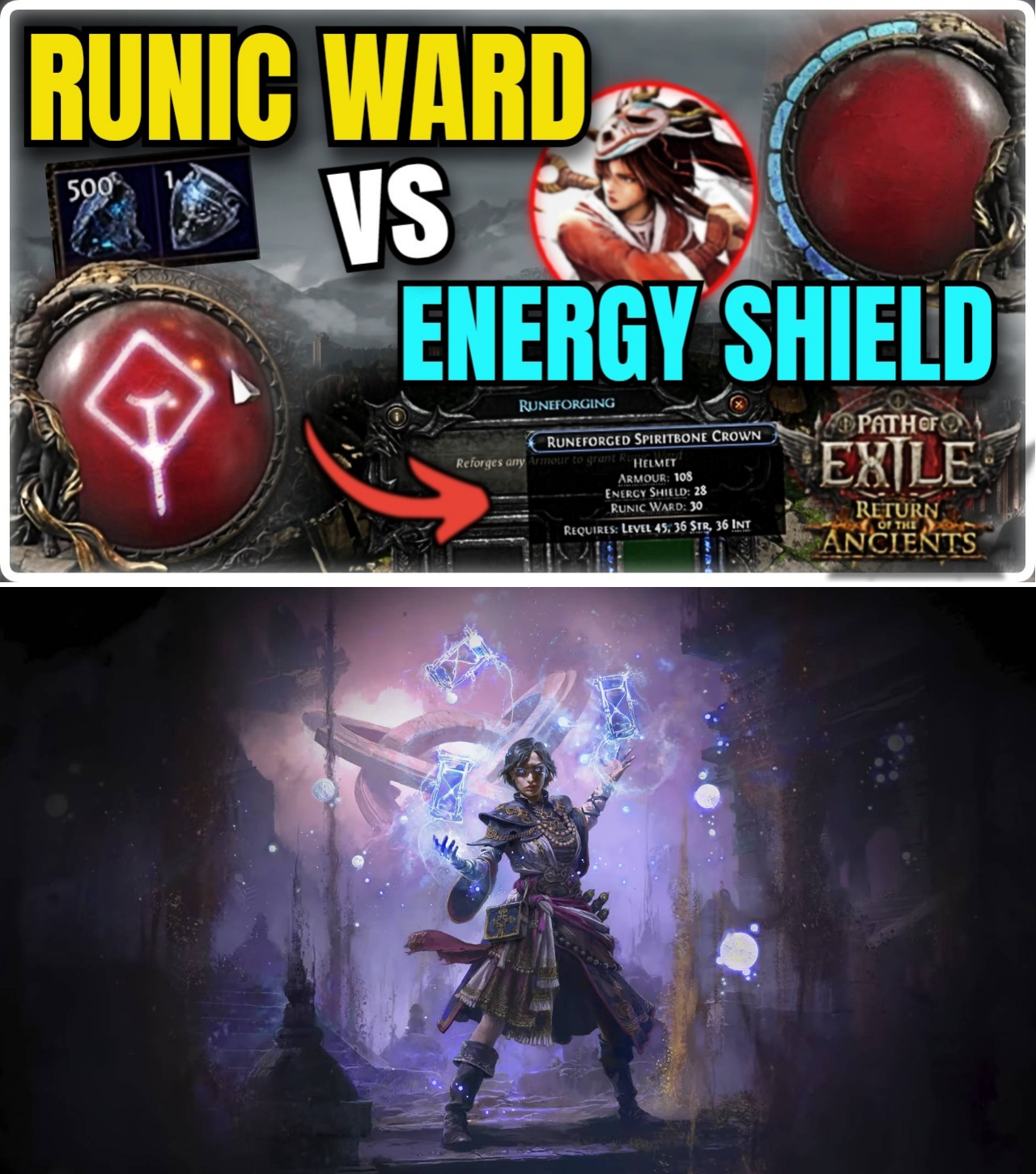
As the Path of Exile 2 (PoE 2) community gears up for the 0.5 “Return of the Ancients” update, defensive mechanics have become the most debated topic in the theory-crafting sphere. Central to this discussion is Runic Ward, a new defensive layer introduced by Grinding Gear Games (GGG) that many believe could finally rectify the long-standing “Life issue” that has plagued non-Energy Shield (ES) builds since the start of Early Access.
The “Life Issue” Explained
For many players, particularly those running right-side-of-the-tree builds like Rangers or Monks, the current endgame has been punishing. Due to the scarcity of Life nodes on the passive skill tree and the inefficiency of Life on gear, these builds have historically been forced to transition into Energy Shield to survive. Without this transition, players often cap out at a measly 2,000 to 2,500 Life, leaving them vulnerable to one-shots and overwhelmed by endgame damage spikes.
What is Runic Ward?
Runic Ward functions as “inverse Energy Shield.” Unlike ES, which sits atop a player’s life pool and depletes first, Runic Ward activates only after a player’s life reaches one. It is not a “cheat death” mechanic; rather, it acts as a secondary buffer that absorbs incoming damage directly after the life pool is exhausted.
One of the most praised aspects of the new mechanic is its ease of use. While Energy Shield requires significant investment in recovery (a factor that is becoming increasingly difficult as GGG targets ES recovery for nerfs, such as adjustments to Ghost Dance), Runic Ward appears to function “out of the box.” It features natural, fast-starting recovery that doesn’t suffer from the same weaknesses as ES—namely, the susceptibility to Damage Over Time (DoT) effects like burning ground.
A Tool for the Many, Not the Few
Crucially, Runic Ward appears to be designed specifically for Life-based builds. Because it triggers only after Life is lost, it offers little benefit to high-ES builds (which may reach 10,000 ES). This targeted design suggests that GGG is consciously trying to provide a competitive defensive option for players who do not wish to go the ES route.
However, the efficacy of the system remains theoretical. Players like Fubgun have noted that the “success” of Runic Ward depends entirely on investment potential. “If we can reach 1,000 Ward with reasonable investment,” the theory-crafter posits, “that would honestly feel quite comfy.” Conversely, if the scaling caps out too early, Runic Ward may be relegated to a mid-game novelty rather than an endgame staple.
The Risk of the “Trap”
Despite the optimism, some members of the community remain wary. As GGG prepares to move into the final stages of the game’s development, the concern is that by nerfing traditional ES recovery and promoting Runic Ward, the developers might be creating a “false choice.” If ES recovery is gutted too aggressively, players might feel forced into Runic Ward, not because it is inherently better, but because it is the only remaining option that functions without massive, high-end investment.
With the 0.5 update set to roll out on May 29, the community will soon find out if Runic Ward is the solution that transforms “glass cannon” builds into viable endgame contenders, or if it represents another layer of complexity that creates more problems than it solves. For now, the verdict is split: for those tired of the mandatory ES meta, Runic Ward is a beacon of hope; for the skeptics, it is a variable yet to be tested under the pressure of the endgame.
News

The “Return of the Ancients” Dilemma: Can Path of Exile 2’s Biggest Update Save its Early Access Reputation?
GGG’s MASSIVE 0.5 UPDATE: Salvation or The Final Nail for PoE 2? 🚨 The Path of Exile 2 community is absolutely in flames right now. With the “Return of the Ancients” (0.5) update confirmed as the final major patch before…

THE INFINITE PRESSURE: How the New Dual Sword Build is Melting Bosses in Crimson Desert
Is this the most BROKEN Dual Sword build ever? 😳 The “Infinite Stamina Heavy Attack” spam is literally melting bosses in seconds, and the community is calling it totally unfair! ⚔️ By stacking the Momentum and Stamina Transference Abyss Gears,…

THE RUINS GOLDMINE: Elite Excavation Routes That Are Breaking the Crimson Desert Economy
Are you still wasting your workers on low-tier missions? 🤯 The latest update made Ruins Excavations repeatable, and if you aren’t farming these specific sites, you’re missing out on exclusive Blueprints and Abyss Artifacts that make your gear god-tier! ⚔️…
THE ATOR-SLAYER: How a “Volcano Eruption” Loop is Destroying the Crimson Desert Boss Meta
Is this the most BROKEN build in Crimson Desert history? 🤯⚔️ Elite players have just revealed a “Volcano Eruption” infinite-loop build that makes the game’s toughest bosses, including the legendary Ator, Archon of Antumbra, look like absolute pushovers! By stacking…

THE ERNAND GOLDMINE: Elite Community Discover New Resource Hub for Abyss Gear and Power Cores
Found the ultimate endgame honey hole! 💎 Only 1% of players know about this hidden location under Ernand that is absolutely STACKED with Abyss Gear, Abyss Cells, and rare Power Cores! 🤯⚔️ Stop wasting time on inefficient grinds. This secret…
LIQUID GOLD: Exploit at Arboria Castle Gives Crimson Desert Players Infinite Water and Sparks Economy Panic
The Crimson Desert economy is literally breaking down after Patch 1.07 unexpectedly unlocked an insane infinite loot exploit that the devs are rushing to hotfix! 🚨💧 Forget paying for supplies or wasting hours at the well. Players have just discovered…
End of content
No more pages to load