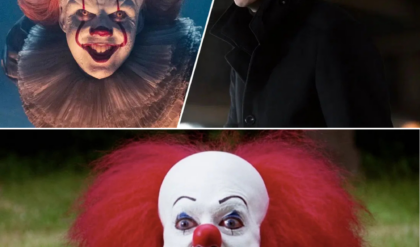
You think Pennywise is just a clown who hides in sewers and feeds on kids’ fears? Think again.
In the jaw-dropping finale of HBO’s IT: Welcome to Derry, the monster doesn’t just know your deepest terrors… he knows your FUTURE.
Bloody, broken Pennywise stares down a terrified girl on frozen river ice and pulls out a MISSING poster—of her unborn son. A boy who won’t even be born for years. The same boy who grows up to help DESTROY him in the movies.
He laughs and drops the bomb: “Tomorrow, yesterday… it’s all the same to little Pennywise.”
Time isn’t linear for this ancient evil. Past, present, future—all happening at once. He SEES his own death coming… and he’s already trying to rewrite it by targeting the parents of the Losers’ Club before they even exist.
Is this full-on time travel? A cosmic cheat code to cheat death forever? Or is Pennywise trapped in his own nightmare loop where his end is also his beginning?
The twist changes EVERYTHING about the IT universe. Fans are losing their minds over the paradoxes, the retcons, and what it means for Season 2.
Read more:
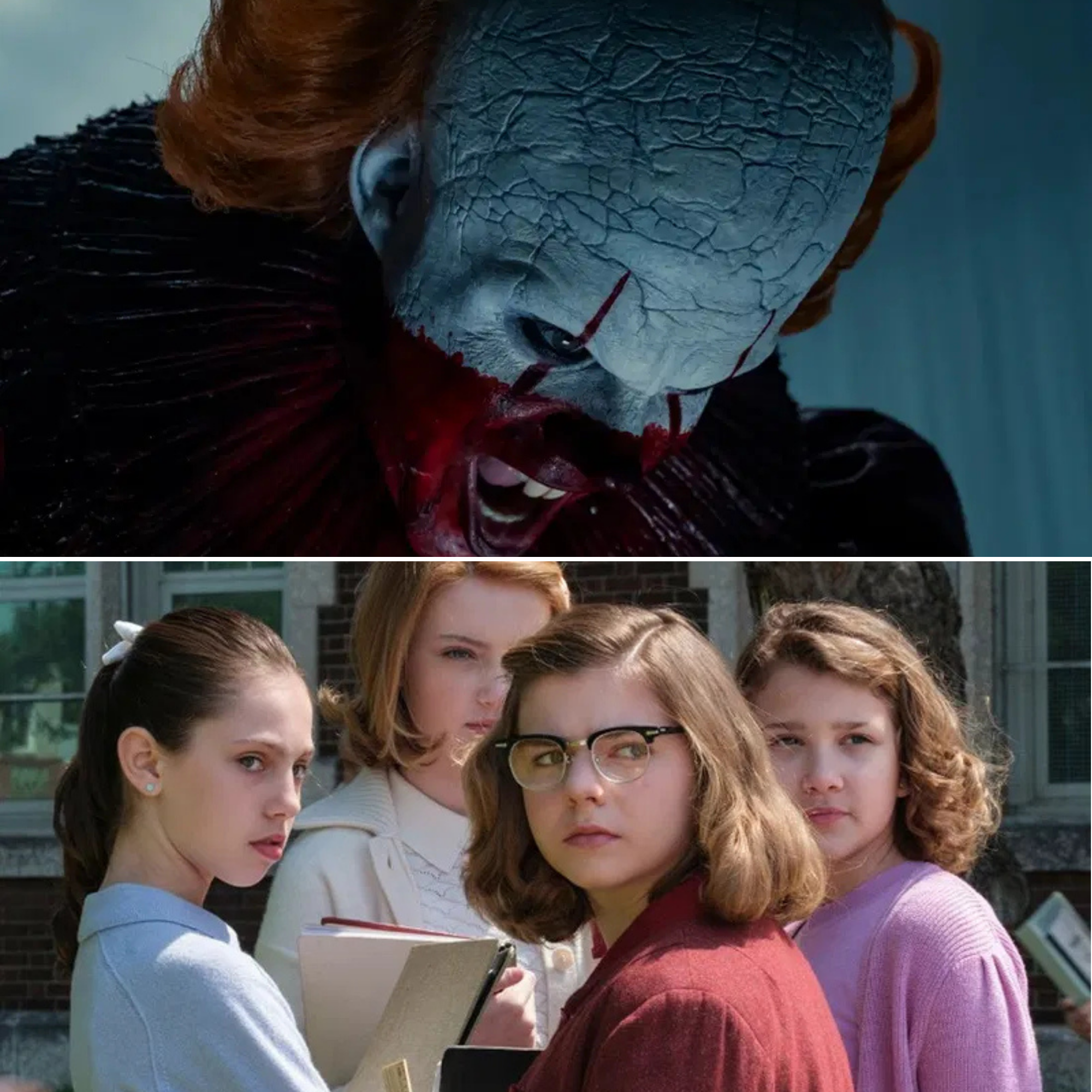
The season finale of HBO’s IT: Welcome to Derry dropped a bombshell that has left Stephen King fans reeling: Pennywise, the shape-shifting entity terrorizing Derry for centuries, appears to possess knowledge of events far beyond the 1962 setting of the prequel series. In a chilling confrontation on the frozen Derry River, the clown – played once again by Bill Skarsgård – confronts a young girl named Marge and reveals details about her future son, Richie Tozier, a key member of the Losers’ Club who helps defeat It decades later in the 2017 and 2019 films.
The scene unfolds with Pennywise, bloodied and battered from battle, producing a “missing” poster featuring Richie (famously portrayed by Finn Wolfhard as a child and Bill Hader as an adult in the movies). He taunts Marge with the knowledge that her words echo those her son will one day speak – words that contribute to Its downfall. When Marge questions how this is possible, Pennywise delivers the line that has sparked endless debate: time, for him, is not a straight line. “Tomorrow, yesterday… it’s all the same,” he says, implying a non-linear perception where past, present, and future coexist simultaneously.
This revelation marks a significant expansion – some might say alteration – of Pennywise’s abilities as established in Stephen King’s 1986 novel It and the blockbuster film adaptations directed by Andy Muschietti. In the original story, Pennywise (or “It”) is an ancient, interdimensional creature that crash-landed on Earth eons ago, hibernating for 27-year cycles to feed on fear, particularly that of children. Its powers include shapeshifting, illusion creation, telepathy, and manipulation of reality within Derry’s borders. Precognition or overt time manipulation was never explicitly part of the package.
Yet Welcome to Derry, which premiered on HBO in October 2025 and concluded its first season in December, introduces this twist in its closing moments. The prequel, set in 1962 during one of Pennywise’s earlier awakenings, follows a new group of young protagonists confronting the entity 27 years before the events of the 1980s films. Marge, it turns out, grows up to become Richie’s mother, creating a direct bridge to the Losers’ Club. Pennywise’s awareness of this lineage – and his apparent attempt to eliminate Marge to prevent Richie’s birth – suggests the creature is actively trying to alter its doomed fate.
Critics and fans have been quick to dissect the implications. Outlets like Screen Rant described the moment as a “shocking Pennywise time travel twist” that makes the entity “even more terrifying.” Esquire asked bluntly: “Yes, Pennywise Can See the Future. But How?” The consensus among breakdowns is that Pennywise does not literally “time travel” in the conventional sci-fi sense – no DeLorean-style jumps through wormholes. Instead, as an eternal, cosmic being from outside our dimension (often linked to the “Deadlights” and the macroverse in King’s lore), It perceives time as a single, overlapping continuum. Everything – Its arrival on Earth, Its cycles of terror, Its eventual defeat by the adult Losers in 2016 – exists at once.
This non-linear existence explains why Pennywise knows about Richie before the boy is conceived. It also raises uncomfortable questions: If the creature sees its own death coming, why hasn’t it prevented it already? Some fan theories on platforms like Reddit and TikTok suggest Pennywise is trapped in a closed time loop. Its “death” in It: Chapter Two – reduced to a vulnerable, infantile state before exploding – is simultaneously Its “birth” or rebirth in another cycle. The entity may be aware of every failure across millennia but powerless to break free from the pattern, confined to Derry and its 27-year rhythm.
Others point out potential retcons. In King’s novel, the Losers’ Club defeats It through belief, unity, and the Ritual of Chüd – a psychic battle drawing on childhood imagination. The films leaned into emotional catharsis. Introducing future knowledge could undermine that victory: if Pennywise knew the outcome, was the win truly earned, or merely inevitable? Some commentators argue the show opens doors for Season 2 to explore alternate timelines or deeper multiverse connections, perhaps tying into King’s broader cosmology (the Dark Tower series, where time and reality bend in complex ways).
HBO and the show’s creators, including Muschietti, have not fully clarified the mechanics, leaving room for interpretation. Skarsgård, who executive produces and reprises the role, has described the prequel as an opportunity to explore “sides of old Pennywise” unseen before. The finale’s events – including a military intervention, a mysterious pillar tied to the entity’s hibernation, and foggy manifestations some link to King’s The Mist – build toward this existential reveal.
For viewers, the twist amplifies Pennywise’s menace. No longer just a predator waiting out cycles, It becomes a being that glimpses its own extinction yet persists, perhaps manipulating events across eras in subtle ways. Marge’s survival ensures Richie’s existence, but the implication lingers: what if It targets other bloodlines in future seasons set in 1935, 1908, or earlier?
The series has drawn praise for its atmosphere, performances (including Chris Chalk as a young Dick Hallorann, connecting to The Shining), and faithful expansion of Derry’s cursed history. Visual effects have drawn some criticism, but the narrative ambition – blending 1960s social issues like racism with cosmic horror – has kept audiences hooked.
As Welcome to Derry sets up potential continuations, one thing is clear: Pennywise’s game has changed. Whether this is precognition, higher-dimensional awareness, or something closer to true time alteration, the clown who floats has gained a terrifying new layer. In Derry, no one – not even the future – is safe.