IS UBISOFT’S “CHECKLIST” FORMULA OFFICIALLY DEAD?
The gaming world is in a heated debate after critics pointed out the brutal truth: Crimson Desert is exposing the biggest flaw in modern AAA development.
While Ubisoft continues to churn out “bloated” maps filled with identical assets and repetitive chores, Pearl Abyss is setting a new benchmark. Fans are calling it the difference between a “manufactured product” and a “handcrafted world.” But is the “Ubisoft style” of game design—those endless icons and fetch quests—becoming a relic of the past, or are players just getting tired of the same cycle?
The gap between these two philosophies has never been wider. Are we witnessing the end of an era for the industry giants?
See the side-by-side comparison that’s driving the community crazy: 👇🔥
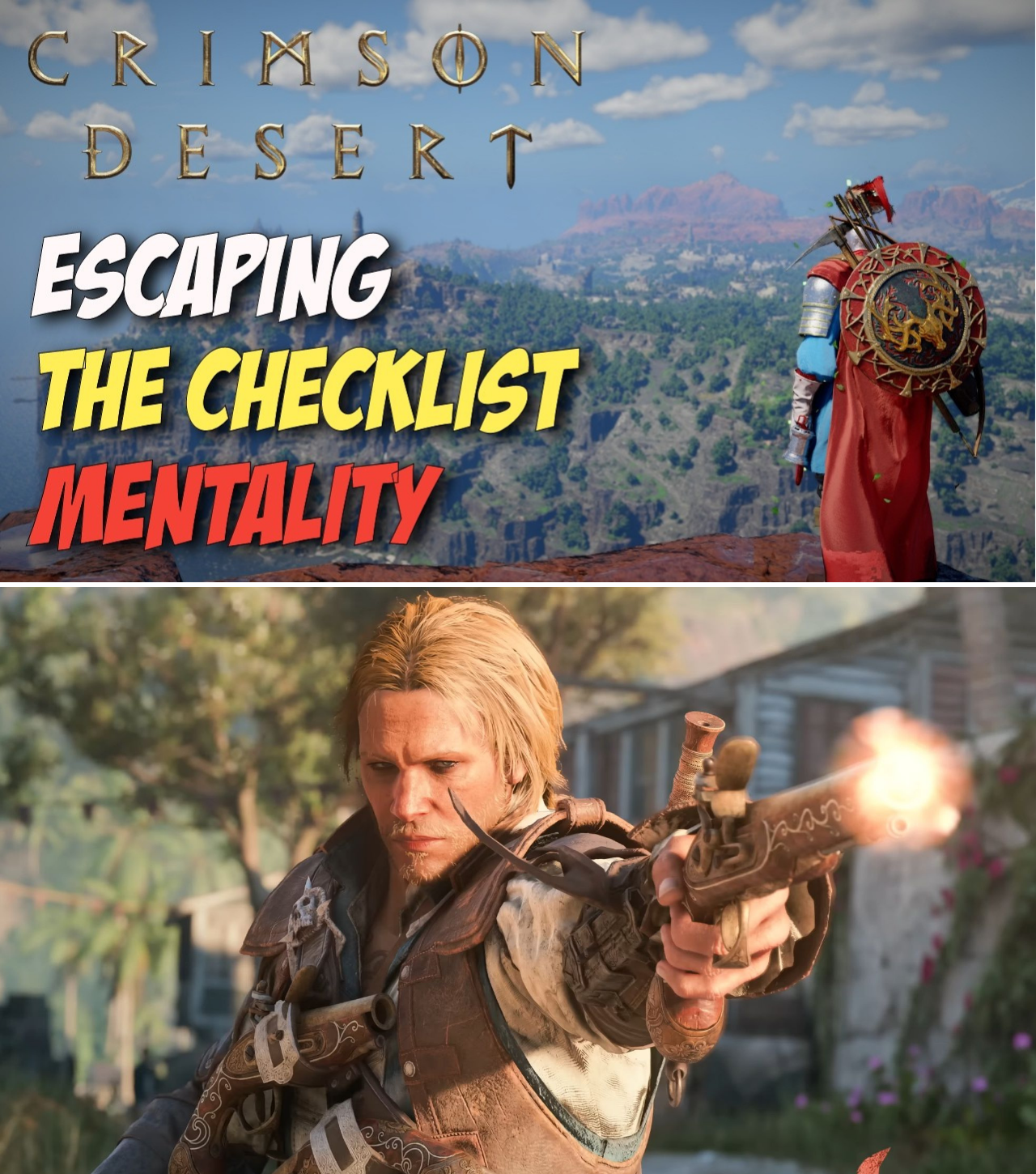
In the vast, interconnected landscape of modern AAA gaming, few structural templates have enjoyed the dominance—and subsequently, the scrutiny—of the “Ubisoft formula.” For over a decade, this design philosophy has defined how players interact with open worlds: map-clearing mechanics, endless icons, repetitive side-quest cycles, and a sense of scale that often prioritizes quantity over depth. However, the 2026 launch of Crimson Desert has arrived as a disruptive force, acting as an unintentional—or perhaps calculated—critique of this industry-wide stagnation. As players and analysts scrutinize the game’s evolution through its aggressive post-launch update cadence, a broader debate has ignited: are we witnessing the sunset of the “checklist” era of game design?
The Architecture of Immersion: Asset Diversity vs. Repetition
To understand why Crimson Desert is being framed as a benchmark, one must look at the granular level of world-building. A persistent, and often fair, criticism leveled against modern Ubisoft titles—such as Assassin’s Creed Valhalla or the recent Assassin’s Creed Shadows—is the issue of “asset fatigue.” In these games, the sheer size of the world map often necessitates the heavy reuse of architectural assets. Players report that after dozens of hours, settlements begin to bleed into one another; Viking-style longhouses in one region appear identical to those hundreds of miles away in another, despite geographical and cultural differences.
When a major urban center like London—historically and culturally distinct—is constructed using the same modular building pieces as a minor village, the illusion of a “living world” fractures. The player ceases to explore a real place and starts navigating a “set” designed to minimize development costs.
In direct contrast, Crimson Desert leverages its proprietary “Black Space Engine” to achieve a level of visual and structural distinctiveness that is becoming rare in the AAA space. Hernand, for instance, radiates an aura of regal authority, characterized by its elevated castle architecture and bright lighting. Meanwhile, the sprawling metropolis of Deminis feels like a true, bustling urban center, contrasting sharply with the secluded, serene atmosphere of Poon, which sits nestled beneath jagged, snow-capped peaks. Further south, the desert settlements of Tomaso offer an entirely different cultural aesthetic—mud-brick architecture and specific environmental details that ground the player in a different regional reality.
This isn’t merely a matter of aesthetic preference; it is a matter of psychological retention. Because every location in Crimson Desert feels distinct, the player is more likely to remember their journey. They are navigating a world with an internal logic, rather than a map filled with “points of interest” that could be copy-pasted from one quadrant of the world to another without the player noticing the difference.
The Myth of “Busy Work” and the Quality-of-Life Mandate
The divide between these two philosophies extends deep into the game design loop. The “Ubisoft formula” has long been synonymous with “busy work.” In many of their recent open-world titles, the player is presented with a map cluttered with icons: shrines, meditation spots, painting mini-games, and bandit camps. While these activities provide a momentary sense of progression, they often fail to offer meaningful narrative stakes. Clearing a camp in one sector of the map often feels identical to clearing one in another, with only the enemy count changing to simulate difficulty progression.
Pearl Abyss has taken a noticeably different approach. By integrating over 400 side quests into the world, the studio has sought to solve the problem of “quest bloat.” Crucially, these are not just simple fetch quests; they are narrative-driven, voice-acted, and designed to integrate into the player’s journey through the world. While some tasks may boil down to delivery, they are contextualized by the world-building and character arcs of the NPCs involved.
Furthermore, the game’s recent updates, particularly Patch 1.09, demonstrate a commitment to streamlining the player experience—not by removing challenge, but by removing friction. The introduction of the “Tool Equipment Slot” and the ability to assign seeds to “Quick Slots” reflects a development team that is listening to the community’s frustrations with mundane interface tasks. This is a crucial distinction: where some studios view player friction as “gameplay duration,” Pearl Abyss seems to view it as a failure of design that must be patched out.
The Financial Paradox: Why “Player-First” is Paying Off
The most striking aspect of the current debate is the financial reality. Critics of Crimson Desert—or at least, those who are skeptical of its “player-first” rhetoric—often point out that the game is a for-profit enterprise, just like any other. However, the Q1 2026 earnings report for Pearl Abyss reveals a 2,584.8% increase in operating profit, with Crimson Desert contributing roughly $180 million in revenue during its first partial quarter.
These figures challenge the prevailing wisdom in the gaming industry, which suggests that “long-term success” requires predatory monetization or the rapid “pump and dump” release cycle of mid-tier titles peppered with microtransactions. Pearl Abyss is proving that a high-engagement, high-quality experience can generate massive returns when combined with a consistent, community-driven content pipeline.
Industry observers, including notable figures like Warhorse Studios director Daniel Vavra, have frequently commented that a studio with over 16,000 employees should, in theory, be capable of producing multiple “Game of the Year” level projects simultaneously. The fact that many gamers feel Ubisoft’s recent output—Avatar: Frontiers of Pandora, Star Wars Outlaws, and Assassin’s Creed Shadows—has struggled to reach the critical heights of games like Kingdom Come: Deliverance 2 or Crimson Desert speaks to a systemic issue. It is not a lack of talent or capital; it is a lack of focus on the core player experience and a reluctance to evolve the outdated “checklist simulator” formula.
Toward a New Industry Standard
We are arriving at a crossroads in open-world game design. The “manufactured” approach—where games are designed as products to be consumed and discarded—is finding increasing resistance from a player base that is becoming more discerning and less willing to tolerate “bloat.”
Crimson Desert is not a perfect game; it has its share of rough edges and narrative inconsistencies. Yet, it serves as a powerful argument against the inevitability of the industry’s current trajectory. It proves that there is a massive, hungry market for worlds designed to be lived in rather than just ticked off.
As we look toward the future—the rumored DLC, the ambitious “impossible” Nintendo Switch 2 port, and the ongoing expansion of the game’s combat and exploration systems—the message from Pearl Abyss is clear. They are positioning Crimson Desert not as a one-and-done release, but as a multi-year project akin to the legacy of The Witcher 3. They are building a world that grows alongside its community.
If this experiment continues to yield high returns, the rest of the AAA industry will be forced to take notice. The success of Crimson Desert will not just be measured in sales, but in the potential ripple effect it has on game design. Will other studios move away from the map-heavy checklist model? Will they invest in more handcrafted, narrative-dense world-building? If they want to remain competitive in a landscape where player engagement is increasingly tied to the quality of the “live” experience, they may have no choice but to follow.
For now, the gap between the two philosophies—the manufactured simulator versus the handcrafted world—is growing wider. While Ubisoft and other giants continue to refine the model that made them successful a decade ago, smaller and mid-sized studios are finding success by taking risks, listening to community feedback, and prioritizing purpose-driven design. The game has changed, and those who remain stuck in the old ways of the “checklist” may soon find themselves left behind, their icons forgotten while the worlds they built remain empty, while players continue to forge new paths in worlds that promise something more than just a reward at the top of a tower.
News

The Multi-Million Dollar Gamble: Is Crimson Desert Redefining the Modern RPG Roadmap?
IS CRIMSON DESERT BECOMING THE “WITCHER 3” OF 2026? Stop ignoring Crimson Desert. While most of the industry is busy charging you for “Day 1 DLC,” Pearl Abyss is pulling a move that is literally rewriting the rules of the…
The Redemption Arc: Patch 1.09 and the Evolution of Crimson Desert
IS CRIMSON DESERT FINALLY THE “PERFECT” RPG WE WERE PROMISED? The devs just dropped Patch 1.09 and the community is absolutely losing their minds—but for a reason nobody expected. While everyone was busy arguing over the story, Pearl Abyss quietly…

The Drift Meta: 5 Essential Builds for Your Forza Horizon 6 Garage
Ditch the stock rides—these 5 drift builds are breaking the Forza Horizon 6 leaderboards! 🏎️💨 Stop struggling with “twitchy” handling and endless spins. We’ve found the 5 essential RWD drift builds that every player needs in their garage to dominate…
The Precision Edge: Optimizing Your Controller and Difficulty in Forza Horizon 6
Is your controller holding you back in Forza Horizon 6? 🏎️🎮 If your steering feels “floaty” or your throttle response is lagging, you’re likely fighting default settings that weren’t built for competitive racing. From deadzone “sweet spots” that eliminate stick…

10 Common Mistakes That Are Slowing Your Progression in Forza Horizon 6
STOP wasting your credits in Forza Horizon 6! 🛑🏎️ Are you still making these 10 rookie mistakes? From blowing your early cash at the Auto Show to ignoring the most overpowered farming trick in the game, most beginners are doing…

The JZX100 Renaissance: Building the Ultimate Tandem Drift Machine in Forza Horizon 6
The “Street King” of Forza Horizon 6 has arrived! 👑🔥 The Toyota Chaser JZX100 is finally here, and it’s not just a legend—it’s the definitive tandem drift weapon for the mountain passes of Japan. Whether you’re chasing doors in tight…
End of content
No more pages to load