🚨 3I/ATLAS is barreling toward the Sun at blistering speeds, unleashing bizarre gases and anomalies that have Harvard and NASA on edge—what if it’s not just a comet, but something far more sinister? The shocking discoveries emerging now could rewrite everything we know. Dive in before it vanishes behind the Sun! 👉
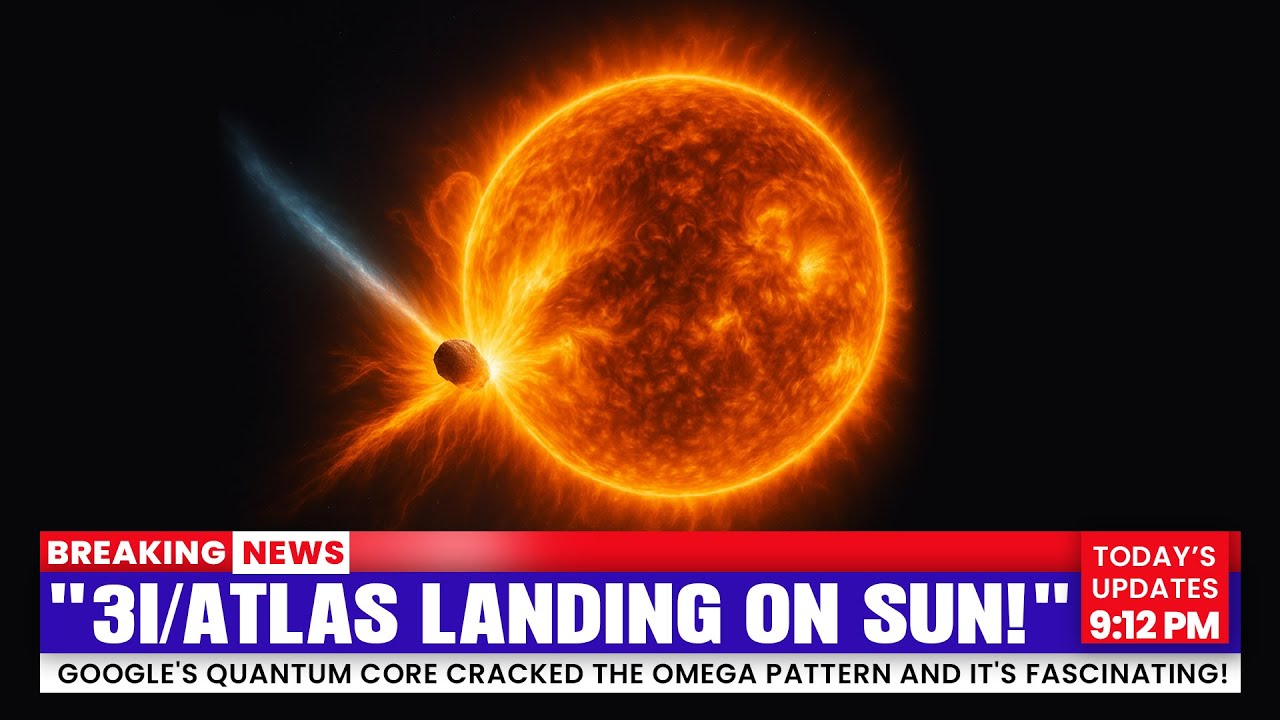
The interstellar comet 3I/ATLAS, hurtling toward its closest approach to the Sun on October 29, 2025, has astronomers at Harvard and NASA confronting a slew of baffling discoveries that challenge conventional understanding of cosmic wanderers. Dubbed “anomalously massive” by Harvard astrophysicist Avi Loeb, the object—estimated to weigh over 33 billion tons with a nucleus spanning more than 5 kilometers—exhibits chemical signatures and behavioral quirks that some experts describe as “terrifying” in their implications for interstellar origins. As the comet races inward at speeds exceeding 60 kilometers per second, its path raises questions about whether this visitor from beyond our solar system is a natural icy relic or something engineered from a distant stellar neighborhood.
Discovered on July 1, 2025, by NASA’s Asteroid Terrestrial-impact Last Alert System (ATLAS) telescope in Chile, 3I/ATLAS marks only the third confirmed interstellar object to grace our solar system, following the enigmatic ‘Oumuamua in 2017 and 2I/Borisov in 2019. Its hyperbolic trajectory, originating from the direction of Sagittarius near the Milky Way’s core, confirms it is unbound by the Sun’s gravity, destined to sling back into deep space after perihelion—a point just inside Mars’ orbit at about 1.4 AU (130 million miles). Yet, as it nears the Sun, observations reveal anomalies that have sparked both scientific intrigue and fringe speculation.
One of the most alarming findings comes from NASA’s James Webb Space Telescope (JWST), which on August 6 detected a coma dominated by carbon dioxide (CO2) at an unprecedented ratio of 8:1 to water ice—far exceeding typical comets and suggesting formation in an ultra-cold environment or exposure to exotic radiation. Additional volatiles like carbon monoxide (CO), carbonyl sulfide (OCS), and amorphous water ice were identified, painting a picture of a composition unlike anything in our solar system. Harvard’s Loeb, in a recent paper co-authored with Richard Cloete and Peter Veres, argues this “extreme abundance” implies the comet’s nucleus is insulating, suppressing water sublimation while allowing CO2 to dominate—potentially hinting at artificial engineering. NASA’s SPHEREx mission corroborated these findings, revealing a vast CO2 coma spanning 3 arcminutes and outgassing rates of 9.4 × 10²⁶ molecules per second, with minimal water or CO detected.
Compounding the mystery, the Very Large Telescope (VLT) observed atomic nickel (Ni I) emissions surging without corresponding iron (Fe I)—a violation of natural cometary chemistry where the two metals typically outgas together. Production rates hit ~10²² atoms of Ni per second alongside cyanide (CN) plumes emerging unusually early, at heliocentric distances where such activity is rare. This “industrial-grade nickel” without iron has fueled speculation of an electroplated shell, a hallmark of manufactured materials rather than pristine cosmic ice. The comet also shows carbon-chain depletion, with weak C₂ emissions marking it as one of the most depleted objects known, further distancing it from solar system norms.
Size estimates have escalated dramatically. Hubble’s July 21 imaging suggested a nucleus 1-5.6 km across, but non-gravitational acceleration limits—under 15 meters per day squared despite evident outgassing—imply a mass exceeding 33 billion tons to conserve momentum. This makes 3I/ATLAS 3-5 orders of magnitude more massive than ‘Oumuamua or Borisov, a “major anomaly” per Loeb, who questions why such giants are so rare given interstellar debris models. Polarimetric observations reveal “extreme negative polarization,” differing sharply from known comets, potentially indicating a distinct surface or structure.
Behavioral oddities abound. Hubble captured a sunward-pointing dust plume—an “anti-tail” defying standard cometary tails that stream away from the Sun—stretching 10 times longer than wide. Color shifts from red to green, possibly tied to cyanide production, add to the enigma, with some attributing it to unidentified chemical processes. Precovery data from TESS hints at activity as early as May 7, when the comet was 6.4 AU out, unusually distant for such behavior. Its retrograde, ecliptic-aligned path—tilted just 5 degrees—facilitates flybys of Mars (October 3 at 17-29 million miles), Venus, Earth (1.8 AU closest), and Jupiter (0.36 AU in March 2026), a 1-in-20,000 statistical rarity.
NASA missions are mobilizing for glimpses. Mars rovers Perseverance and Curiosity, plus orbiters like Mars Reconnaissance Orbiter (HiRISE) and ESA’s Mars Express, will image the October 3 flyby. ESA’s Juice at Jupiter may capture post-perihelion activity in November, while NASA’s Parker Solar Probe could observe via WISPR from September to November. However, perihelion coincides with solar conjunction, hiding the comet behind the Sun from Earth-based views, obscuring potential outbursts or fragmentation.
Loeb’s provocative theories—that 3I/ATLAS could be a technological artifact, perhaps deploying mini-probes during planetary passes or leveraging a “reverse Solar Oberth maneuver” at perihelion—have drawn sharp rebukes. NASA officials emphasize classical cometary activity, with no threat to Earth and no evidence of artificial signals or propulsion. Critics like Darryl Seligman affirm JWST data shows standard outgassing, while Jacqueline McCleary notes the CO2-rich makeup offers planetary chemistry insights without invoking extraterrestrials. Fringe claims of radio signals, metallic alloys, or course corrections remain unverified, often traced to misinterpretations or hoaxes.
Social media buzz amplifies the drama, with posts speculating on “electroplated shells” or “motherships,” echoing ‘Oumuamua debates. Yet, scientists like those at Lowell Observatory prepare dawn-dusk observations to track changes. Age estimates peg it at 7.6-14 billion years, possibly from the Milky Way’s thick disk of ancient stars.
As 3I/ATLAS fades behind solar glare until December, its passage underscores the Vera C. Rubin Observatory’s potential to detect more such objects, revolutionizing exoplanetary studies. Whether harbinger of doom or scientific goldmine, this “terrifying” interloper reminds us of the universe’s unresolved riddles—natural or otherwise.
News

The Deep Freeze – Analyzing the “Broken” Frost Meta in Crimson Desert
STOP scrolling—you’ve been building your Frost character all wrong. ❄️🔥 Everyone is obsessed with pure damage, but while you’re out here chasing DPS numbers, the real pros are running a Frost build that is legitimately broken. I’m talking about infinite…

The Honeymoon Ends – Examining the Polarizing Reality of Crimson Desert
70 hours later, and I’m uninstalling Crimson Desert. Was the hype just a lie? 🔥 We’ve all seen the posts calling Crimson Desert the “next Skyrim.” But after grinding through the campaign, the reality is starting to set in. Beyond…

The Silent Revolution – Why Crimson Desert is Challenging the Gaming Establishment
The game legacy media is afraid to talk about… and it’s arguably the greatest open world ever made. 🌍🔥 Check the math: 93% of Crimson Desert players haven’t “finished” the game. Not because it’s too hard, but because they simply…

The MMO Paradox – Inside the Infinite Loop of Crimson Desert
Stop trying to “complete” Crimson Desert. You’re being played. 🔥 Ever sat down to knock out some side quests, only to realize 11 days later that you’re brewing alchemy potions, managing a livestock ranch, and chasing a legendary mount you…

The Maritime Horizon – Is Pearl Abyss Preparing to Re-Define the Open World Genre?
CRIMSON DESERT’S FIRST DLC IS LEAKED… AND IT CHANGES EVERYTHING. ⚓️🔥 Five million copies sold. A patch schedule that puts every other AAA studio to shame. And now? The silence is finally broken. Pearl Abyss has officially confirmed in their…

The “Living Map” Paradox – Is Crimson Desert’s Relentless Evolution a Masterstroke or a Burden?
The game that literally won’t let you quit… and it’s driving completionists absolutely insane. 🔥 Ever feel like you’ve finally “beaten” an open-world game, only to find the map you spent 200+ hours clearing has changed overnight? Most developers give…
End of content
No more pages to load