THE BLASPHEMOUS BLADE IS “UNDERPOWERED”? 😱 I put it to the ultimate test and the results are… confusing.
Everyone keeps saying this weapon is either broken or completely useless, but after an entire playthrough, I’ve finally uncovered the truth that the community is hiding. I walked into the Lands Between with nothing but this sword, and let’s just say, my sanity was tested in ways I didn’t think were possible—from “cheating” bosses to moments where the game literally felt like it was breaking.
Is this the most overrated weapon in Elden Ring, or have we all been playing it wrong? The ending of this run actually shocked me.
See the chaos for yourself here: 👇
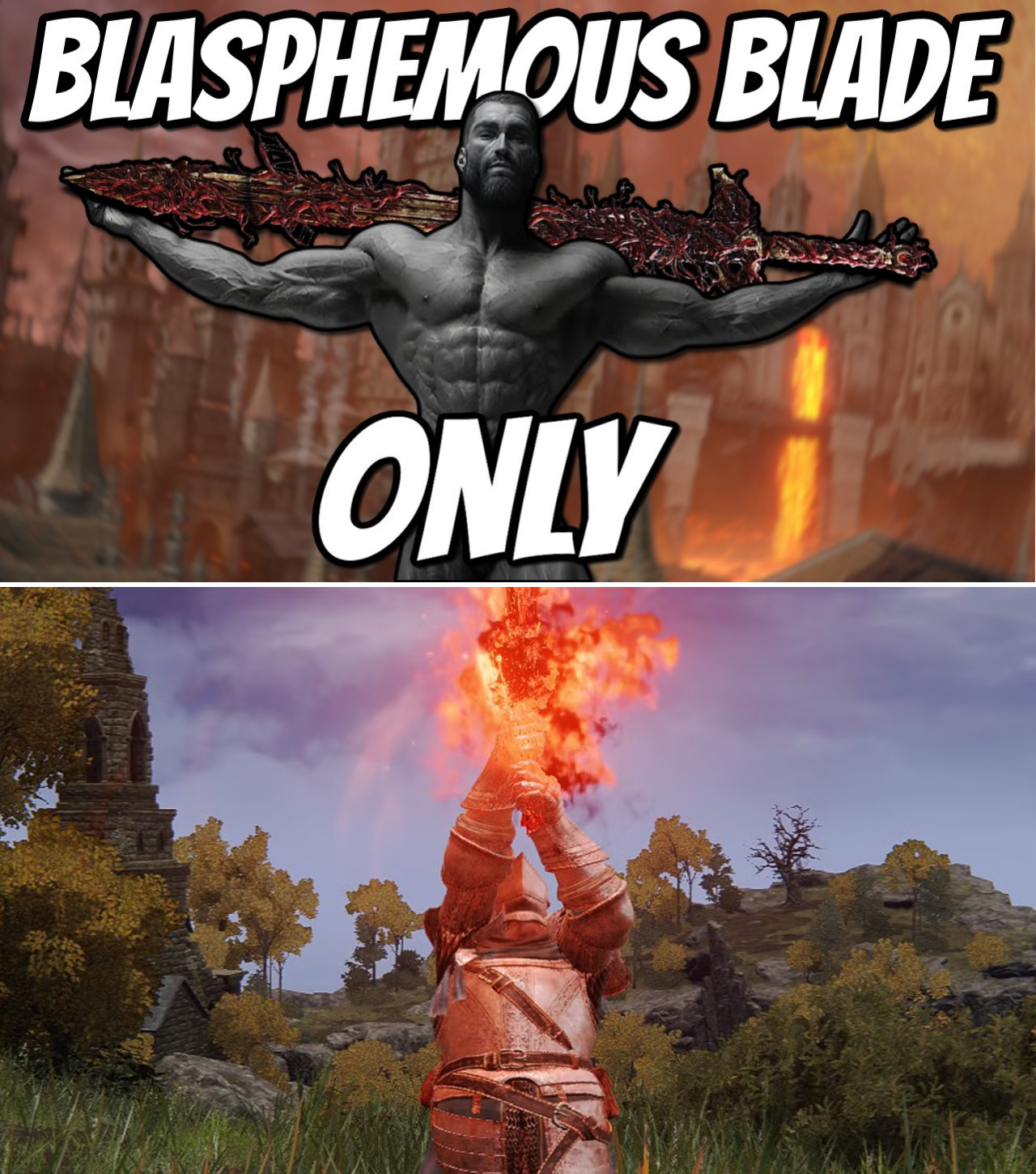
In the sprawling, merciless world of Elden Ring, few items have sparked as much debate as the Blasphemous Blade. Often heralded as one of the game’s most powerful tools, it has simultaneously been the subject of satirical “challenge runs” that question its true effectiveness. Recently, content creator Tuxyii took this debate to the extreme, attempting a full playthrough using only this Greatsword. The result? A journey that highlights the bizarre discrepancy between community perception and actual boss-encounter reality.
The Myth of the “Impossible” Challenge
The Blasphemous Blade, obtained via the Remembrance of the Blasphemous after defeating Rykard, Lord of Blasphemy, is legendary for its unique Ash of War, Taker’s Flames. This ability allows players to launch a wave of fire that deals massive damage while healing the user. Despite this, Tuxyii framed the challenge as a test of “patience, skill, and perseverance,” tongue-in-cheekly labeling the weapon as “underpowered” to play on the community’s tendency to inflate the difficulty of specific playstyles.
The run began in Limgrave, with the player opting for the Samurai class to secure early-game utility before rushing toward the Volcano Manor. The route involved meticulous planning: securing the Dectis Medallion halves, defeating minor bosses for Runes, and optimizing build pathing with key items like the Flame-Shrouding Cracked Tear and the Ritual Sword Talisman.
Tactical Hurdles and Boss Room Drama
The narrative arc of the challenge was defined by several high-stress encounters. Against the Godskin Noble in Volcano Manor, Tuxyii employed a specific strategy involving sleep pots—a staple for veteran players—to bypass the boss’s aggression. However, the run was not without technical anomalies. During the fight, the player encountered bizarre AI behavior that led them to openly accuse the game of “cheating,” a sentiment often echoed in frustrated Reddit threads when players encounter erratic boss hitboxes [03:08].
As the player progressed to Rykard, they swapped to the game-provided Serpent-Hunter spear, emphasizing that even in specialized runs, situational adaptation is required [03:35]. The core of the frustration, however, was not the weapon itself, but the boss’s natural resistance to fire damage, which made many late-game encounters—particularly the Fire Giant—a grueling test of attrition. “Not only was I doing essentially negative damage, but the Fire Giant is an extremely tanky boss,” Tuxyii noted during the struggle [11:56].
Community Reaction and The “Meta” Illusion
What makes this run particularly intriguing is the juxtaposition of the weapon’s perceived strength versus the player’s lived experience. Throughout the run, Tuxyii frequently critiqued the weapon’s damage output during key fights like Morgott, the Omen King, and Maliketh, the Black Blade.
Yet, the stats tell a different story. By utilizing buffs like Flame, Grant Me Strength and the Ritual Sword Talisman (providing a 10% damage increase at full HP), the player was still able to overcome some of the game’s most difficult bosses, albeit with significant effort. This highlights a common trend in the Elden Ring community: weapons are often labeled as “broken” because they trivialize content, but when stripped of optimized buffs, players quickly rediscover the mechanical skill required to survive.
The DLC Test: Shadow of the Erdtree
The true test came with the entry into the Shadow of the Erdtree expansion. Facing bosses like Rellana, Twin Moon Knight and Messmer the Impaler, the challenge reached a boiling point. The player noted that while the weapon’s Ash of War could stagger enemies effectively, it was susceptible to being interrupted or missing entirely due to boss mobility [24:10].
The commentary during the Messmer fight provided a fascinating look at the “cycle of frustration” in Elden Ring—the point where players feel the game is inherently unfair because their chosen tool isn’t performing up to expectations [28:30]. By the time the final boss was defeated, the run had served as both a testament to the weapon’s viability and a critique of the player’s own “greed” in combat—a classic hallmark of Elden Ring gameplay.
Final Verdict
Ultimately, Tuxyii concluded the video with a lighthearted reveal: “The Blasphemous Blade is probably one of the best weapons in the game” [34:07]. The entire challenge was an elaborate April Fool’s joke, effectively satirizing the way the Elden Ring community obsesses over “tier lists” and “broken builds.”
The run successfully proved that in Elden Ring, the most dangerous variable is not the weapon, but the player’s ability to manage their expectations and adapt to the boss’s moveset. Whether you wield the Blasphemous Blade or a basic club, the journey through the Lands Between remains a test of endurance—one where the “broken” weapons are often just as challenging as any other if you approach them with enough hubris.
News
The Rune Forging Revolution: Transforming Unique Body Armours in Path of Exile 2 Version 0.5
🔥 IS YOUR UNIQUE GEAR TRASH? NOT ANYMORE! With the new 0.5 “Rune Forging” mechanic, GGG is officially turning “useless” uniques into endgame monsters! We’re talking about massive base defense buffs and the new “Runic Ward” defensive layer that could…
The End of Deterministic Power: Massive Crafting Nerfs Rock Path of Exile 2 Version 0.5
🚨 CRAFTING IS DEAD? GGG Just Dropped the Biggest Nerf in POE2 History! Did you hear that? It’s the sound of thousands of god-tier items vanishing into thin air. A last-minute change in the 0.5 patch notes just sent the…
The Patch of Reckoning: Winners and Losers of the Massive Path of Exile 2 Version 0.5 Update
THE POE2 0.5 “NUCLEAR” PATCH IS HERE. Is your main build dead? ☢️ The developers just dropped a massive 0.5 patch, and it is a bloodbath. They’ve completely nuked some of the most iconic playstyles, including Poison Pathfinder, Infernal Legion…
The 0.5 Powerhouses: Three Builds Defining the Path of Exile 2 League Start Meta
🔥 THE META IS HERE! 3 Builds That Will CRUSH Path of Exile 2 Patch 0.5! The new patch notes are in, and while everyone is panicking about the nerfs, the real pros are already locking in their starters. Want…
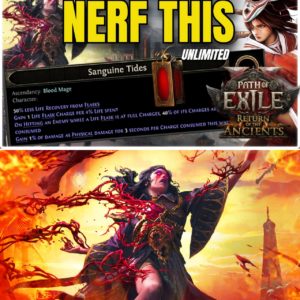
The Unkillable Meta: How CoC Comet Bloodmage Defies 0.5 Nerfs in Path of Exile 2
THEY TRIED TO KILL IT, BUT IT’S BACK. 🚨 CoC Comet Bloodmage is STILL the King of POE2 0.5! The developers thought the 0.5 nerfs would finally bury the most broken build in the game. They were dead wrong. The…

The 0.5 Shake-Up: Major Nerfs and a Massive Skill Tree Expansion Rock Path of Exile 2
🚨 POE2 0.5 SHAKEDOWN: Is your build still alive? The devs just dropped a massive, stealth-patch update and everything you thought you knew about your endgame scaling is in danger. We’re talking massive nerfs to staple nodes like Subterfuge Mask…
End of content
No more pages to load