IS CRIMSON DESERT THE “WITCHER 3” MOMENT FOR ELDER SCROLLS 6?
Bethesda has been silent on The Elder Scrolls 6 for years, banking on their legendary reputation. But the gaming landscape just shifted under their feet. Crimson Desert didn’t just launch; it evolved. From a “janky” debut to a polished, open-world powerhouse, its aggressive update cadence and deep simulation systems have turned it into the benchmark for what an RPG should be in 2026.
Is Bethesda’s “Creation Engine” legacy finally falling behind? With Crimson Desert proving that players crave more than just “Bethesda-style” sandbox tropes, the pressure is on. Can Todd Howard’s team still deliver, or has the genre already moved on without them?
The stakes for TES6 just hit an all-time high. See why the community is losing faith in the “Bethesda formula”: 👇 🔥
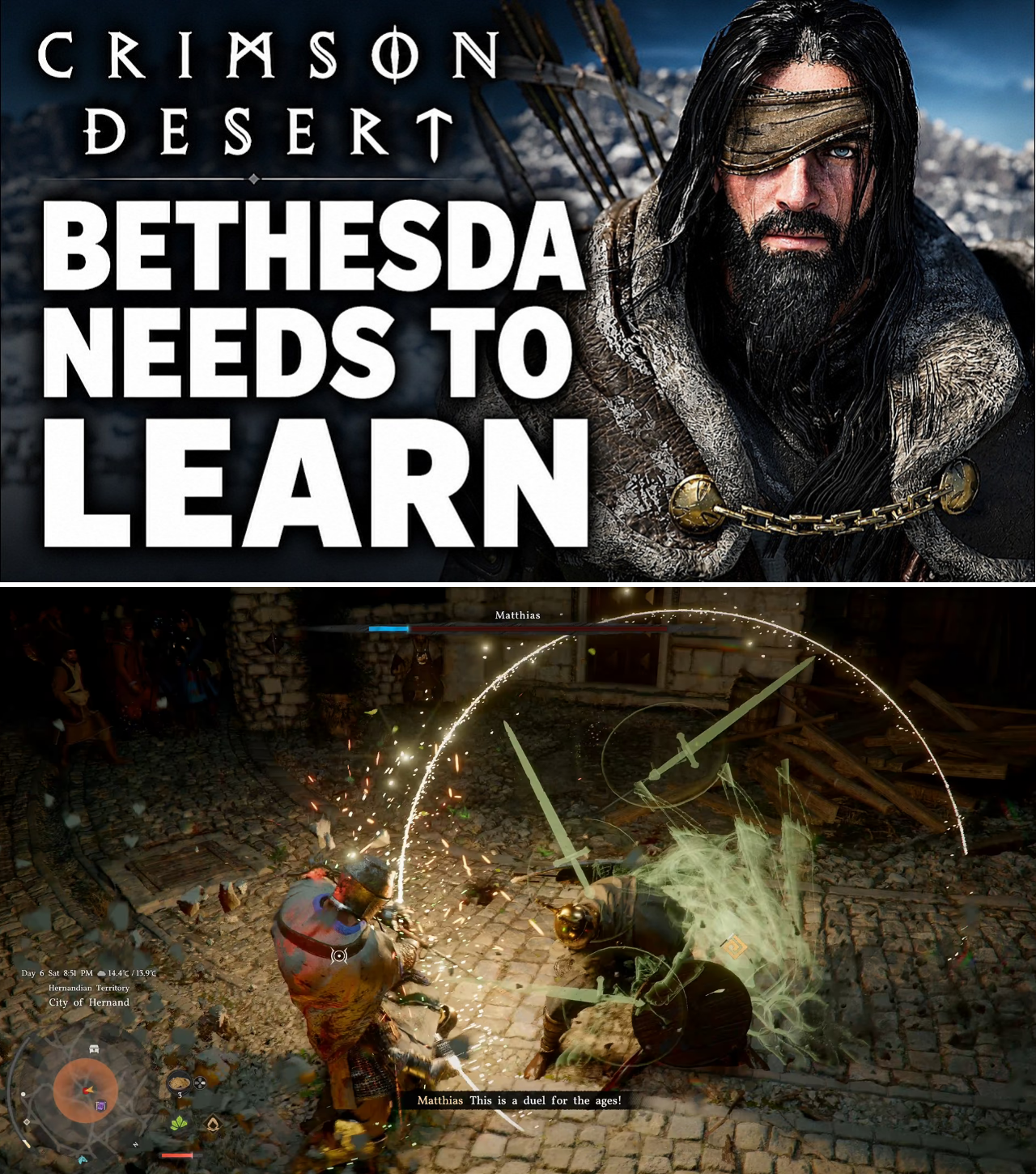
For over a decade, the “Bethesda formula”—a blend of vast, moddable sandboxes, radiant AI, and “one more cave” exploration—has been the undisputed gold standard for open-world RPGs. The Elder Scrolls V: Skyrim remained the genre’s North Star, a title that provided a level of freedom and emergent storytelling that few developers dared to replicate. However, the 2026 release and the subsequent, rapid iterative evolution of Crimson Desert have introduced a disruptive reality: the market’s definition of a “masterpiece” has fundamentally shifted. As Bethesda Game Studios works behind the scenes on the highly anticipated The Elder Scrolls VI, they are doing so under the long, imposing shadow cast by Pearl Abyss’ latest epic.
The Evolution of the “Forever Game”
The most significant impact Crimson Desert has had on the industry is its post-launch trajectory. Historically, Bethesda’s development cycle has relied on long periods of silence, punctuated by massive, static releases that were then left to the modding community to “perfect.” In contrast, Pearl Abyss has adopted a “live-evolution” strategy. By taking a game that received mixed critical reactions at launch—due to concerns over controls and technical polish—and systematically patching, refining, and expanding it into a cohesive experience, they have demonstrated a level of responsiveness that feels alien to the traditional “AAA” release model.
For Bethesda, this raises a difficult question: Does The Elder Scrolls VI need to be a finished product at launch, or does the modern player now expect a platform that grows, learns, and reacts to their feedback in real-time? The “patch-first” philosophy of 2026 suggests that the honeymoon phase of a launch has shortened; players are no longer willing to wait years for mods to fix fundamental issues.
Technical Ambition and the Engine Wall
Technically, Crimson Desert has exposed the limitations of aging engines. Bethesda’s Creation Engine 2 (and the upcoming iteration for TES6) has always been praised for its object persistence and mod-friendliness. Yet, players accustomed to the frequent loading screens, rigid physics, and “stiff” animation systems of the Elder Scrolls series are finding the seamless transitions, advanced physics-based combat, and high-fidelity environment simulation of the “Black Space Engine” difficult to overlook.
The ability to traverse from a high mountaintop to a dense, populated dungeon without a single loading screen—a staple of the current generation of open-world games—is no longer a “nice-to-have.” It is now a baseline expectation. When players look at the dynamic foliage, destructible environments, and fluid traversal mechanics of Crimson Desert, the prospect of The Elder Scrolls VI relying on an engine that still struggles with complex verticality or seamless interior-exterior transitions feels increasingly antiquated.
Systemic Depth vs. Scripted Exploration
Bethesda games are often praised for their ability to allow players to “do anything,” but Crimson Desert pushes this further into the territory of systemic interaction. Where Bethesda might use scripted events to flavor exploration, Crimson Desert utilizes interconnected systems—animal taming, regional faction influence, and physics-based environmental interaction—that create truly emergent narratives.
In Crimson Desert, shooting a fire arrow into a vine-choked doorway isn’t a scripted puzzle solution; it is a systemic result of the world’s internal logic. This rewards player curiosity in a way that feels organic rather than curated. For the average player, this means exploration is driven by internal desire rather than a trail of quest markers. If The Elder Scrolls VI follows the traditional “go here, talk to NPC, kill objective” loop without integrating deeper systemic interactions, it risks feeling like a relic of 2011, regardless of how beautiful the world looks.
The “Skyrim” Safety Net Is Gone
For years, the “safety net” for Bethesda was the implicit promise that The Elder Scrolls VI would be the definitive successor to Skyrim. This promise allowed the studio to weather the storm of Fallout 76 and the mixed reception of Starfield. However, patience is not infinite. With Crimson Desert currently filling that specific niche—providing massive scale, deep exploration, and hundreds of hours of content—the urgency to wait for Bethesda has plummeted.
The “demand” for a new Elder Scrolls experience is being actively sated by other titles. If TES6 launches and feels like a re-skinned version of Starfield or a modest evolution of the Skyrim engine, it faces the risk of being viewed as a “product of the past” rather than an industry leader. The genre has moved on, and the audience has been conditioned to expect a higher tier of responsiveness and technical fidelity.
Conclusion: A Balancing Act for Bethesda
It would be a mistake to count Bethesda out. Their ability to foster community through modding tools remains a moat that no other studio can easily cross. However, the stakes for The Elder Scrolls VI have undeniably been raised. The modern open-world RPG player now demands high-fidelity visuals, meaningful physics, and responsive, long-term development support.
Crimson Desert has shown that you don’t need the Elder Scrolls name to provide the definitive exploration experience. Whether Bethesda can synthesize their unique strengths—moddability, deep lore, and unparalleled world-building—with the modern technical and design standards pioneered by titles like Crimson Desert will determine if The Elder Scrolls VI is remembered as a return to form or a relic of a bygone era. The game is no longer just about the map size; it’s about the life within it, and for the first time in a decade, the king of the genre has a real fight on its hands.
News
Handcrafted vs. Manufactured: Why Crimson Desert is Challenging the AAA Status Quo
IS UBISOFT’S “CHECKLIST” FORMULA OFFICIALLY DEAD? The gaming world is in a heated debate after critics pointed out the brutal truth: Crimson Desert is exposing the biggest flaw in modern AAA development. While Ubisoft continues to churn out “bloated” maps…

The Multi-Million Dollar Gamble: Is Crimson Desert Redefining the Modern RPG Roadmap?
IS CRIMSON DESERT BECOMING THE “WITCHER 3” OF 2026? Stop ignoring Crimson Desert. While most of the industry is busy charging you for “Day 1 DLC,” Pearl Abyss is pulling a move that is literally rewriting the rules of the…
The Redemption Arc: Patch 1.09 and the Evolution of Crimson Desert
IS CRIMSON DESERT FINALLY THE “PERFECT” RPG WE WERE PROMISED? The devs just dropped Patch 1.09 and the community is absolutely losing their minds—but for a reason nobody expected. While everyone was busy arguing over the story, Pearl Abyss quietly…

The Drift Meta: 5 Essential Builds for Your Forza Horizon 6 Garage
Ditch the stock rides—these 5 drift builds are breaking the Forza Horizon 6 leaderboards! 🏎️💨 Stop struggling with “twitchy” handling and endless spins. We’ve found the 5 essential RWD drift builds that every player needs in their garage to dominate…
The Precision Edge: Optimizing Your Controller and Difficulty in Forza Horizon 6
Is your controller holding you back in Forza Horizon 6? 🏎️🎮 If your steering feels “floaty” or your throttle response is lagging, you’re likely fighting default settings that weren’t built for competitive racing. From deadzone “sweet spots” that eliminate stick…

10 Common Mistakes That Are Slowing Your Progression in Forza Horizon 6
STOP wasting your credits in Forza Horizon 6! 🛑🏎️ Are you still making these 10 rookie mistakes? From blowing your early cash at the Auto Show to ignoring the most overpowered farming trick in the game, most beginners are doing…
End of content
No more pages to load