Autonomous Drone Pollination Swarms Help Almond Growers Hedge Against Colony Losses
In an illustrative Central Valley pilot, coordinated drones dusted pollen over orchard rows to supplement rented honeybee hives, giving almond growers one more option at bloom.

Key takeaways
- check_circleDrones are positioned as a supplement to honeybee hives during almond bloom, not a replacement.
- check_circleAlmonds depend on insect pollination, and hive rental is a major, volatile cost for growers.
- check_circleOpen questions: pollen handling, coverage versus bees, cost per acre and effects on bee welfare.
In this illustrative launch-edition report, a pilot in California’s Central Valley tests whether swarms of small autonomous drones can help almond growers manage one of agriculture’s tightest timing problems: bloom. The pilot treats the machines as a backup layer, working alongside rented honeybee hives rather than displacing them. Details below describe a scenario, not a verified commercial deployment.
An orchard that cannot pollinate itself
Almonds are unusually dependent on insects. Most commercial varieties are not self-fertile, which means a flower needs pollen from a different compatible variety delivered by a pollinator. Orchards are therefore planted in alternating rows of varieties, and during a few weeks of late winter, growers need enormous numbers of foraging bees moving between them.
That demand is so large that the almond industry is widely described as the biggest single pollination event in American agriculture. Beekeepers truck hives in from across the country, and growers rent them by the acre. Because bloom is short and weather decides whether bees fly at all, a cold, rainy week can shrink the effective pollination window dramatically.
The pressure on hive supply
Honeybee colonies face stress from parasites, disease, pesticide exposure, poor forage and weather. Beekeepers routinely report seasonal colony losses, and replacing them is costly. When supply tightens, rental prices can climb, and growers have little room to negotiate because the bloom date cannot be moved.
Growers in the pilot described the tension plainly:
“Hives are the biggest line we cannot control. If a storm sits on us during bloom, we are watching the clock and hoping the bees get a few good afternoons.” — an orchard manager in the pilot
That risk is what the drone experiment is designed to address. It is not trying to solve colony health, only to give growers an additional tool when conditions are poor.
How the swarm works
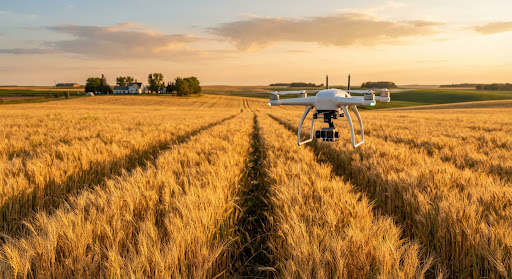
In the pilot setup, a fleet of small multirotor drones flies pre-programmed passes along orchard rows at low altitude. Each carries a hopper of collected, dried almond pollen, which it releases in a controlled puff or mist as it moves over the canopy. A ground station coordinates the fleet so that drones do not overlap, collide or leave gaps, and an onboard camera and sensors help each unit hold position relative to the trees.
A few elements make this more than a gadget:
- Timing: drones can fly in short windows between showers, when bees stay in the hive.
- Targeting: flight paths can be tuned to row layout and to the stage of flower opening.
- Pollen supply: the pollen must be collected from compatible varieties, stored properly and kept viable, which is a supply chain of its own.
A supplement, not a substitute
Insects do something drones struggle to replicate. A bee visits a flower, brushes against the anther, and carries pollen through its body hair to the next blossom, often visiting many flowers in a trip. The drone approach is closer to dispersal from above, relying on pollen reaching stigmas by settling or air movement. Early pilots in specialty crops elsewhere have shown the approach can work to some degree, but coverage and fruit set typically trail what healthy bee activity achieves.
For that reason the pilot frames the drones as insurance. A grower might keep contracted hives at a standard stocking rate and bring in the swarm during a stretch of bad weather, or for blocks where bee traffic is thin. The goal is a more resilient bloom, not an orchard without bees.
What is not yet known
The pilot is small, and nothing here has been independently verified. Open questions are numerous. How does fruit set from drone-assisted blocks compare with bee-only blocks across several seasons? What does the full cost per acre look like once pollen collection, drone maintenance, battery logistics, trained operators and aviation rules are included? Does low-altitude flight near trees in bloom disturb foraging bees, and could noise or rotor wash affect them?
Bee welfare deserves explicit attention. Any technology that reduces hive demand could, in principle, help lighten the strain of long-haul migration on colonies, but it could also reduce income for beekeepers who depend on pollination contracts. The effect on the beekeeping community, positive or negative, has not been studied here and should be part of any broader rollout conversation.
What to watch next
Several markers will show whether the idea has legs. Look for multi-season yield comparisons published with methods transparent enough for outside review. Watch for realistic per-acre pricing that works for mid-size growers, not only the largest operations. And watch how beekeepers, growers and drone operators collaborate, since the most durable outcome may be a mixed system in which each pollinator does what it does best.
The pilot is a useful reminder that resilience in agriculture often comes from adding options rather than swapping one dependency for another. If drones can reliably cover the gaps when weather and colony losses squeeze the bloom, they will earn a place in the toolbox. If they cannot match the economics or the results, the effort will still have clarified how much work the humble honeybee does each spring.
infoLaunch edition: this story is an illustrative scenario. Figures are attributed to the sources named in the text and have not been independently verified. Nothing here is investment, legal or financial advice. See our Editorial Standards and Corrections Policy.
Written by
Maya Linden
AgTech Senior Correspondent. Newsroom staff in the launch edition are illustrative personas. About us • Report an error