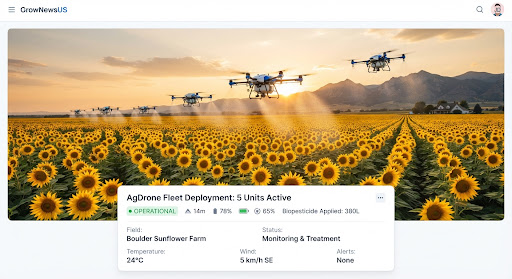
Colorado Drone Fleet Replaces Chemical Crop Spraying Across 300,000 Organic Acres
In this illustrative launch-edition report, a Colorado scaleup says its spray drones apply biological inputs across roughly 300,000 organic acres, replacing much conventional ground and aerial spraying.
Key takeaways
- check_circleThe unnamed scaleup reports its drones now cover roughly 300,000 organic acres.
- check_circleDrones apply biopesticides and beneficial microbes in low volumes, with the aim of reducing drift.
- check_circleAcreage and outcomes are company-reported; independent efficacy data are not yet available.
In this illustrative launch-edition report, we examine a Colorado agricultural-services scaleup, left unnamed here, that says its fleet of spray drones now treats roughly 300,000 organic acres. The company, its figures and its customers are described generically, and the acreage is company-reported. The scenario shows how a young business could use autonomous aircraft to deliver biological crop protection at scale.
For organic farmers, pest and disease management is a constant balancing act. Synthetic pesticides are off the table, so growers rely on crop rotation, resistant varieties, and a growing list of biological products: biopesticides made from naturally occurring organisms or compounds, and beneficial microbes that protect roots or crowd out harmful fungi. The challenge is getting them onto the crop at the right moment, quickly and evenly.
How the drones work
A modern agricultural drone is essentially a flying sprayer with a tank, pumps, nozzles and a flight computer. Operators plan a field boundary on a tablet, set the application rate, and the aircraft flies a pattern at a fixed height above the canopy. Sensors track altitude and terrain, and many units can adjust flow to match speed.
Compared with a heavy ground rig, a drone does not touch the soil. That matters after rain, when wet fields can bog down a tractor and compact the ground. It also matters in tall crops such as corn, where a ground sprayer can damage plants as it passes. Aerial application can reach a field the day a window opens.
Why biologicals suit this approach
Biological products are often time-sensitive. Living microbes can lose viability if they sit in a tank too long or if the spray is applied in hot, bright conditions. Biopesticides frequently need repeat applications at modest rates to stay effective. A flexible fleet that can fly early in the morning, in small blocks, is a natural fit.
The company says it handles mixing and logistics so that farmers receive a service rather than owning equipment. That model has a clear logic: drones and batteries are costly and change quickly, and few growers want to maintain a fleet for a few days of use each season.
“We used to wait for the ground to dry. Now we call a crew and the field is done before lunch.” — an organic grower in the program
Drift, safety and the rules
Spray drift, the movement of droplets away from the target field, is a longstanding concern in agriculture, and organic operations can be especially sensitive to unwanted residues from neighboring land. Drones can help in a few ways, though they do not eliminate the issue:
- Lower flight height. Flying close to the canopy shortens the distance droplets travel.
- Smaller volumes. Concentrated formulations mean fewer gallons per acre.
- Weather limits. Operators typically pause when winds rise, and many programs set clear thresholds.
Federal aviation rules for agricultural aircraft apply to commercial spraying, and operators generally need to meet certification, safety and record-keeping requirements. State agriculture departments add their own rules for applicators. The company says it follows these requirements, though readers should consult official guidance rather than rely on a summary here.
Jobs and skills
Drone fleets create work, but of a different kind. The scenario describes pilots, field technicians who repair and calibrate equipment, battery handlers, and agronomists who plan treatments. Some of these roles can be filled by people with a farm background who are comfortable with technology; others call for training in flight operations and regulatory compliance.
For rural communities, this can be a path to technical jobs without leaving the region. It can also pull workers away from traditional custom-application businesses, whose owners may need to adapt or compete.
What replacing conventional spraying means
The headline claim is that the fleet replaces much of the conventional ground and aerial spraying that would otherwise have covered these acres. It is worth reading carefully. Organic fields do not use synthetic pesticides to begin with, so the claim is best understood as replacing conventional application equipment and methods, such as large tractor-mounted booms and crewed aircraft, with drone-based delivery of approved biological inputs. How much of any customer’s total spraying that represents will vary.
Limits and open questions
Plenty remains unknown. The 300,000-acre figure is company-reported and could count repeat treatments of the same acre differently from unique acres. Independent trials comparing biological control to alternatives under varied weather are limited, and biologicals can perform inconsistently when conditions are not right. Battery life limits how much area one aircraft covers per flight, and bad weather can delay windows exactly when pests peak.
Regulations are also evolving. Rules for larger drones, swarm operations and operations beyond the pilot’s line of sight continue to develop, and could shape how quickly any fleet can expand. Finally, neighbors and communities may have views on low-flying aircraft that no efficiency figure will settle.
What to watch next
Watch for third-party performance data, clear definitions of what counts as an acre served, safety and incident reporting, and the economics for farmers once the novelty fades. If the claims hold up, drone application of biologicals could become a standard service across the Mountain West and beyond. If not, the lesson will still be useful: precision delivery is only as good as the product and the evidence behind it.
infoLaunch edition: this story is an illustrative scenario. Figures are attributed to the sources named in the text and have not been independently verified. Nothing here is investment, legal or financial advice. See our Editorial Standards and Corrections Policy.
Written by
Elena Rostova
Venture & Scaleups Reporter. Newsroom staff in the launch edition are illustrative personas. About us • Report an error