Next-Gen American Vertical Farming Reaches Cash-Flow Breakeven Across Midwest Corridors
In this illustrative scenario, automated hydroponic hubs across Ohio and Illinois report unit-level margins near 28%, and argue that short, sub-500-mile supply chains can pay their own way.

Key takeaways
- check_circleOperators report roughly 28% unit-level margins across 14 facilities in Ohio and Illinois; the figures are unaudited.
- check_circleRecycled water loops of about 93-94% and under-four-hour grocery delivery are the headline operating claims.
- check_circleCash-flow breakeven is not profit: building costs and capital repayment remain outside the headline margin.
In this illustrative launch-edition report, we examine a scenario that would have sounded improbable a few years ago: indoor, automated farms in the Midwest saying they now cover their operating costs. The operators in this scenario are unnamed, and every figure below is operator-reported rather than independently audited.
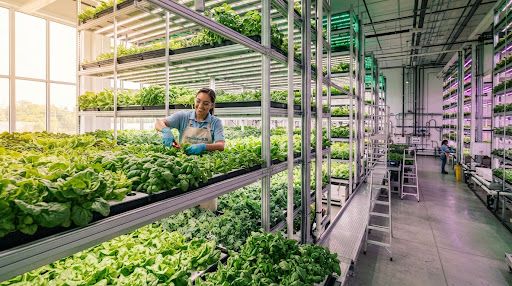
According to the operators, 14 facilities across Ohio and Illinois are running at unit-level margins of around 28%. They grow leafy greens and herbs in automated hydroponic systems, recirculate roughly 93 to 94 percent of their water, and deliver to grocery aisles in Chicago, Indianapolis and Detroit in under four hours. They also say about $1.2 billion in venture infrastructure capital has been redeployed into the sector, a figure reported by operators and investors rather than verified by a third party.
What breakeven actually means
The phrase cash-flow breakeven is easy to misread, so it is worth being precise. It means a facility brings in enough cash from sales to cover its day-to-day operating costs: power, labor, seed, nutrients, packaging and delivery. It does not mean the company has earned back the money spent building the facility, repaid its lenders, or generated a profit for shareholders.
A unit-level margin is a narrower measure still. It looks at one facility, or even one growing room, before corporate overhead, research spending and financing costs. A 28% unit margin can sit comfortably alongside a company-wide loss. Readers should treat the number as a sign that the basic production model works, not as proof that the business is rich.
The economics: energy, labor, light and crop choice
Indoor farming lives or dies on a handful of cost lines, and the operators in this scenario point to the same ones.
- Energy. Lighting and climate control are the largest costs. Operators say they now sign long-term power agreements and shift heavy loads to off-peak hours.
- Labor. Automated seeding, transplanting and harvesting reduce hands-on hours per pound, though skilled technicians are still needed to keep the machines running.
- LED efficiency. Modern LED fixtures turn more electricity into usable light than earlier generations, and tuning the light recipe to each crop trims waste.
- Crop choice. Leafy greens and herbs grow fast, are light, and spoil quickly when shipped far, which is exactly where a nearby indoor farm has an advantage.
Crop choice deserves emphasis. Wheat, corn and soybeans are not on the menu for these facilities; the energy needed to grow a calorie-dense staple under lights makes the math impossible. The model works for high-value, perishable, low-calorie crops that shoppers buy fresh and often.
Why earlier vertical farms struggled
The first wave of vertical farming in the United States had real problems, and the new operators are quick to name them. Many early projects were built to impress investors before the unit economics were proven. They grew too many crop types, chased technology for its own sake, and signed up for expensive electricity with no hedge against price swings.
Distribution was another weak point. A farm that grows beautiful lettuce but has no reliable grocery contract ends up discounting product or composting it. As one operations lead at a facility in this scenario put it:
“The first generation built farms and then went looking for customers. We signed the shelf space first and sized the building to match it.” — an operations lead at one of the facilities
That sequence, demand before construction, is the clearest difference the operators describe between the failures of the past and the facilities of today.
Water, distance and freshness
The 93 to 94 percent recycled water loop is the part of the story that resonates most with farmers who live with drought risk. In a closed hydroponic system, water that is not taken up by the plant is captured, filtered and reused, so consumption falls sharply compared with open-field irrigation of the same crops. How much less depends on the comparison, and the operators have not yet published a standardized method for it.
The distribution claim is more straightforward to picture. A sub-500-mile supply chain, with trucks reaching shelves in under four hours, means produce arrives with more shelf life remaining. Grocers say that matters because shrink, the food thrown away unsold, is a significant cost in fresh produce. The operators argue that fresher product and less spoilage help explain their margins as much as any machine does.
What is not yet known
Several important questions remain open. The margin figures are self-reported and have not been audited, and the operators have not said how they allocate shared costs such as power contracts and maintenance across facilities. It is unclear how durable the grocery agreements are, how they are priced, or what happens if a retailer renegotiates.
There are also questions about scale. Leafy greens and herbs are a limited market, and if many new facilities target the same shelves, prices could fall. The environmental case depends on the electricity mix as well: a farm powered by cleaner generation looks different from one drawing on fossil-heavy supply. None of this has been independently studied across these 14 sites.
What to watch next
Over the coming reporting periods, a few indicators will say whether this is a durable shift or a good quarter.
- Whether operators publish audited, facility-level results rather than summary margins.
- How facilities fare when energy prices rise, since power is the biggest exposure.
- Whether crop variety expands beyond greens and herbs into berries or other high-value items.
- Whether the distribution model holds when a retailer changes terms.
If the economics hold up under scrutiny, the Midwest could become a quiet proving ground for a different idea of regional food: grown close to where it is eaten, in buildings that sip water, and priced to survive on their own cash flow. If they do not, the sector will have learned the same lesson twice. For now, the honest summary is that the numbers are promising, unaudited, and worth following closely.
infoLaunch edition: this story is an illustrative scenario. Figures are attributed to the sources named in the text and have not been independently verified. Nothing here is investment, legal or financial advice. See our Editorial Standards and Corrections Policy.
Written by
Maya Linden
AgTech Senior Correspondent. Newsroom staff in the launch edition are illustrative personas. About us • Report an error