Regenerative Winter Cover Crops Unlock Premium Voluntary Carbon Payments
Farmers planting cereal rye and clover over winter are earning higher-tier carbon payments when they add soil sampling, buyers in a regional program say. The catch is proof.
Key takeaways
- check_circlePremium payment tiers in the illustrative program require soil sampling, not just practice reports.
- check_circleCover crops add organic matter, but measuring soil carbon change reliably takes time and care.
- check_circleSkeptics question permanence and accounting; farmers should weigh sampling costs against payments.
In this illustrative launch-edition report, a regional voluntary carbon program in the Midwest shows how a familiar farm practice is being repriced. Buyers in the program say growers who plant winter cover crops such as cereal rye and clover, and who confirm results with soil sampling, qualify for higher-tier payments than those who only report what they planted. The scenario is a composite, and none of the figures below come from a verified program.
What a cover crop does
A cover crop is planted between cash crops so the field is not left bare through winter and early spring. Cereal rye is a common choice in corn and soybean country because it germinates in cool weather and builds a dense root system. Clover and other legumes add a different benefit by hosting bacteria that fix nitrogen.
Agronomists point to several effects. Roots hold soil in place, slowing erosion. Living cover can soak up leftover nutrients that might otherwise wash away. Residue shades the surface and suppresses some weeds. And the plant material, as roots and surface residue break down, feeds soil organisms and can add organic matter over time.
Why carbon is the headline
Soil organic carbon is the carbon stored in decomposing plant and microbial material in the ground. Plants pull carbon dioxide from the air through photosynthesis, and some portion ends up below the surface. If a practice increases the amount held in soil, the field acts as a small, slow carbon store.
That is the basis for voluntary carbon payments. A buyer, often a company seeking to offset a portion of its emissions or reduce emissions in its supply chain, pays farmers for the estimated carbon stored or the emissions avoided. A program manager described the shift toward measurement:
“Early on, a signed practice report was enough. Buyers now want evidence from the ground, and they will pay more for it.” — a program manager at a regional carbon program
Measurement is the premium
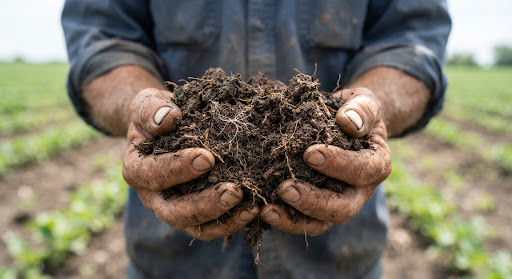
The core challenge is measurement, reporting and verification, often shortened to MRV. Soil carbon changes slowly, usually a small fraction of the total stock each year, and it varies widely even within a single field. Detecting a real increase against that natural noise requires careful sampling at fixed locations and depths, repeated across seasons, with laboratory analysis.
Programs generally use some mix of three approaches:
- Practice-based estimates: payments are tied to documented planting and termination dates using standard models.
- Model-plus-sampling: models estimate outcomes, then soil cores calibrate and check them.
- Direct measurement: repeated sampling of the same points over several years, the costliest option.
Higher-tier payments in the scenario tend to track the third and second approaches, because buyers are paying for confidence. A credit backed by measured change is easier to defend than one based only on a model.
The farm-level math
For a grower, cover crops carry real costs. Seed, planting, termination in spring and management of timing all add expense, and in some years a heavy rye stand can complicate planting the cash crop or tie up nitrogen. Soil sampling adds further cost, plus time. Payments from a carbon program may offset part of that, but they rarely cover everything in the first years.
Many farmers weigh the carbon payment alongside other benefits, such as less erosion, improved water infiltration, potential grazing or forage use, and in some regions cost-share support from conservation programs. The carbon premium, in this view, is one income stream among several rather than the sole reason to plant. Whether it justifies the added sampling is a decision that depends on field size, soil type and contract terms, and this report does not offer advice on it.
The skeptics’ case
Voluntary carbon markets have attracted sharp criticism, and agricultural credits are no exception. Critics raise several concerns. Permanence: stored soil carbon can be released if a farmer later tills heavily or abandons the practice, so a credit might not represent a lasting reduction. Additionality: some farmers might have planted cover crops anyway, in which case the payment does not change behavior. Leakage and baseline questions: it can be hard to say what would have happened without the program. And measurement uncertainty can make credits difficult to compare.
Programs respond with buffer pools, multi-year contracts and conservative discounts, but these are imperfect tools. A reader should treat any single credit’s claims with measured skepticism.
What is not yet known
This scenario does not name a registry, and no independent audit of the payment tiers is available here. Specific price premiums, sampling costs and long-term carbon gains vary by region and are not established. What can be said with confidence is the direction: buyers are asking for stronger evidence, and growers who can supply it may be paid more.
The bottom line
Cover crops are an established practice with agronomic benefits that stand on their own. The carbon payment layer is newer and less certain, but the trend toward sampling-backed tiers suggests the market is maturing. For farmers, the practical question is whether the extra measurement earns its keep. For buyers and the public, it is whether the claims will still look sound when scrutinized years from now.
infoLaunch edition: this story is an illustrative scenario. Figures are attributed to the sources named in the text and have not been independently verified. Nothing here is investment, legal or financial advice. See our Editorial Standards and Corrections Policy.
Written by
Omar Haddad
Soil & Climate Reporter. Newsroom staff in the launch edition are illustrative personas. About us • Report an error