Enhanced Deep Drilling Startups Unlock 24-Hour Zero-Emission Power
Western startups say directional drilling skills borrowed from oil and gas could make enhanced geothermal a firm, zero-emission source for data centers. The promise is real; the open questions are too.
Key takeaways
- check_circleEnhanced geothermal borrows horizontal drilling and fracturing methods to reach heat where conventional geothermal cannot.
- check_circleData centers want firm, around-the-clock power, which is the profile geothermal offers.
- check_circleInduced seismicity, water use and an unproven cost curve remain open questions.
In this illustrative launch-edition report, we look at a group of unnamed startups across the Great Basin that say they can deliver firm, zero-emission power around the clock by adapting drilling techniques perfected in oil and gas. Their pitch is simple: the heat is already under the ground, the rigs and crews already exist, and a growing set of buyers, data centers above all, is looking for electricity that does not stop when the wind drops or the sun sets.
Enhanced geothermal in plain terms
Conventional geothermal power works only where nature supplies three things at once: hot rock, water and permeable rock that lets the water circulate. Those conditions are rare, which is why most US geothermal capacity sits in a handful of western locations.
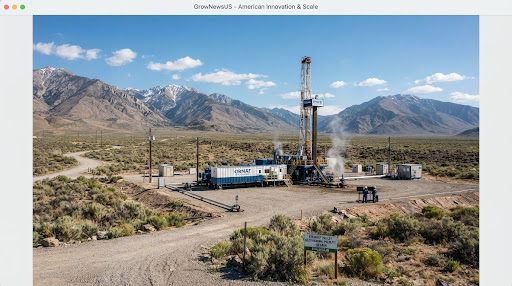
Enhanced geothermal systems, usually shortened to EGS, try to build the missing pieces. Operators drill deep into hot, dry rock, then create or widen pathways for fluid to flow. Cold water is pumped down one well, travels through the engineered fractures, picks up heat and returns to the surface through a second well. At the surface, the hot fluid drives a turbine or a heat exchanger and the cooled water is sent back down in a closed loop.
The idea is not new. What is new is the toolkit available to attempt it.
What oil and gas know-how brings
Two techniques carry most of the weight:
- Horizontal drilling. After going down vertically, a well can turn and run sideways through a target layer for thousands of feet, vastly increasing contact with hot rock.
- Staged fracturing. Methods developed for shale let crews open fractures in controlled sections, allowing operators to build a heat-exchange zone rather than hope for one.
Add real-time downhole sensors, steerable drilling assemblies and decades of data-driven drilling optimization, and the startups argue that geothermal is finally following a cost curve rather than a geology lottery.
There is also a human side. The skills involved, from directional drillers to mud engineers to rig-site supervisors, are the same ones in oil and gas. Founders in this illustrative scenario say recruiting is less about training from scratch and more about offering experienced crews a long-horizon, lower-carbon use for what they already know.
Our drillers did not need a new trade. They needed a new target. — a drilling lead at one of the startups
Why data centers are the natural customer
Large computing campuses run constantly and cannot tolerate gaps in supply. Wind and solar can supply much of the energy, but covering every hour typically requires storage, backup generation or both. Firm clean power, meaning electricity that can be dispatched at a steady level day and night, is a scarce commodity, and buyers that have set their own emissions goals are prepared to sign long-term agreements for it.
Geothermal fits the profile well. Output is steady, the plant footprint is small relative to the energy produced, and the resource does not depend on weather. Several of the startups say they are exploring sites close to transmission and near planned computing campuses, so that power can be delivered with fewer losses and shorter interconnection waits. The developers describe tariffs they believe can be competitive with other firm options, though the specific numbers have not been made public.
The honest unknowns
The case for EGS is strong on paper. The field evidence is still thin, and readers should keep several caveats in view.
Induced seismicity. Injecting fluid and fracturing rock can trigger small earthquakes. Most are too weak to feel, but a few past projects around the world have been paused or ended after tremors drew public concern. Monitoring, conservative pumping pressures and transparent communication with neighbors are essential, and no startup can promise zero risk.
Water use. Closed loops lose some fluid to the rock, and makeup water must come from somewhere. In the arid West, that is a serious question. Developers say they can use treated or brackish sources, but the volumes and the long-term sustainability of those supplies have not been independently demonstrated at commercial scale.
Cost trajectory. Drilling deep, hot wells is expensive, and heat can wear out equipment quickly. Whether costs fall fast enough to compete is the central uncertainty. Early demonstration results are encouraging in the founders' telling, but they are company-reported, and no one yet has a track record of many plants running for many years.
Thermal decline. Rock cools as heat is extracted. How quickly a fracture network loses performance, and how much it can be managed, is still being studied.
What to watch next
The next few years should clarify whether enhanced geothermal graduates from pilot to infrastructure. Watch for projects that publish operating data over many months, including output stability, seismic monitoring results and water balances. Watch whether purchase agreements with data center operators come with disclosed pricing or only headline commitments. Watch permitting timelines on federal and state land, since slow approvals can erase the speed advantage of a modular drilling program.
And watch the workforce. If oil and gas veterans do move over in meaningful numbers, it would show that the energy transition can build on existing skills in communities that know subsurface work well. If EGS delivers, it may offer something the grid badly needs: clean power that simply keeps running.
infoLaunch edition: this story is an illustrative scenario. Figures are attributed to the sources named in the text and have not been independently verified. Nothing here is investment, legal or financial advice. See our Editorial Standards and Corrections Policy.
Written by
Rachel Diaz
Western Energy Reporter. Newsroom staff in the launch edition are illustrative personas. About us • Report an error