New England Shipbuilders Convert Drydocks for Deepwater Wind Assembly
Historic New England maritime yards are converting drydocks to assemble floating wind foundations, and organizers say the work will support union apprenticeships across three states.
Key takeaways
- check_circleUnnamed New England yards are retooling drydocks to build steel and composite floating turbine foundations.
- check_circleOrganizers say the work comes with union apprenticeships spanning three states, with a reported federal match behind it.
- check_circlePermitting, cost pressures and fishing community concerns could slow or reshape the plans.
In this illustrative launch-edition report, we follow a handful of unnamed New England shipyards that are converting drydocks to assemble floating foundations for offshore wind turbines. Organizers describe a pivot from vessels to energy infrastructure, and say the work will come with union apprenticeships across three states. A federal match has been reported to support the effort, though the details are not confirmed here.
Why floating foundations
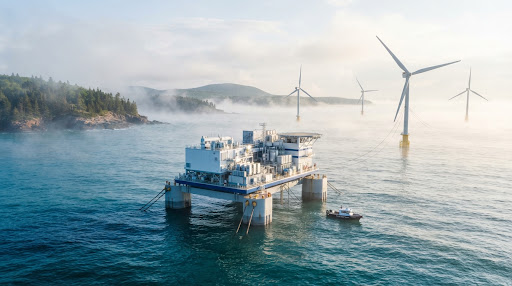
Much of the strongest offshore wind in the Gulf of Maine lies over deep water, where the seabed drops away too steeply for towers fixed to the bottom. Floating turbines solve that problem. The turbine sits on a buoyant platform held in place by mooring lines and anchors, which lets developers reach winds that are steadier and stronger farther from shore.
The platforms come in several designs, including semi-submersible hulls and spar-style columns. Whatever the shape, they are large: steel or concrete-and-composite structures that must be fabricated, joined and outfitted on land or at the quay, then towed to sea. That is precisely the kind of work heavy shipyards have done for generations.
From hulls to platforms
The yards in this scenario already have the basics: deep-water access, large cranes, welding capacity and skilled trades. What they lack, organizers say, is the dedicated layout for serial production of foundations and the ability to integrate a turbine tower and blades at the dock. Converting a drydock typically involves reinforcing quay edges, adding heavy-lift capacity, creating laydown areas for components and building assembly bays that allow repeatable work rather than one-off projects.
- Steel fabrication. Plate cutting, rolling and welding for hulls and columns.
- Composite work. Fabrication of lighter components, an area where boatbuilding experience translates.
- Integration. Mounting the tower and turbine on the finished platform at the quayside.
- Marine operations. Tugs, towing vessels and installation crews to bring finished units to site.
Ports and vessels are as important as the yards themselves. Staging a floating wind farm needs a harbor deep and wide enough to move large platforms, plus a supply chain of specialized ships for mooring and cable laying. Many of those vessels do not yet exist in US flagged fleets, which is itself an opportunity for regional builders.
Apprenticeships and the workforce story
The employment angle is central to how the organizers frame the project. They say the work will be backed by union apprenticeship programs spread across three states, aimed at welders, fitters, electricians, crane operators and marine technicians. The pitch is that trades with a long New England pedigree can be renewed, not replaced.
Plenty of our people grew up around ships. They see a floating platform and recognize a hull. — a training coordinator involved in the apprenticeship effort
Apprenticeships matter for another reason: offshore energy is a long-lead industry. A yard that trains a cohort now has crews ready when orders arrive, rather than competing for scarce workers later. Organizers also say they hope to reach residents of port communities where maritime employment has declined, though no enrollment figures have been published.
Where the money comes from
A federal match has been reported to support the conversion work, which would sit alongside private capital and state contributions. Public co-investment is common for port infrastructure because the facilities serve many projects over many years. How much of the funding is committed versus anticipated, and on what milestones it depends, is not something this article can verify.
The hurdles
Optimism needs to be tempered with specifics. Offshore wind has faced real headwinds in recent years, including higher interest rates, supply-chain inflation and contract renegotiations. Floating wind is earlier in its cost curve than fixed-bottom projects and has fewer commercial-scale references anywhere in the world. A yard that builds ahead of confirmed orders carries risk.
Permitting is another unknown. Offshore leasing, environmental review and port approvals involve federal, state and local agencies, and timelines can stretch. Interconnection to the onshore grid is a further constraint, as is the need for transmission upgrades.
Then there are the people who already use these waters. Fishing communities in the Gulf of Maine have raised concerns about access, gear conflicts and effects on marine habitat. Those concerns deserve serious engagement, not a press release. Organizers say they plan consultation with harbor associations and fishermen, but the scale and outcome of that process have not been demonstrated. Questions about impacts on whales, seabirds and fish stocks also remain subjects of ongoing study.
What to watch next
The first test is whether firm orders follow the retooling. A drydock converted without a customer is a bet, while one with a signed foundation contract is a business. Watch for details on the federal match, including what it requires in terms of local hiring and domestic content. Watch whether apprenticeship cohorts actually enroll and graduate, and whether the trades they enter lead to steady work.
Finally, watch the relationship with fishing communities, since durable offshore wind in New England will depend on consent as much as on steel. If the yards, unions, developers and harbors can align, the region could add a new chapter to a long maritime story. If they cannot, the drydocks will remain what they have always been: capable, historic and waiting for the next order.
infoLaunch edition: this story is an illustrative scenario. Figures are attributed to the sources named in the text and have not been independently verified. Nothing here is investment, legal or financial advice. See our Editorial Standards and Corrections Policy.
Written by
Gwen O'Connor
New England Correspondent. Newsroom staff in the launch edition are illustrative personas. About us • Report an error