How IronPrairie Storage Scaled Grid Battery Enclosures Without Rare-Earth Bottlenecks
In this illustrative case study, a fictional Indianapolis scaleup redesigned battery casings around regional steel and local molding, and reports freight waits falling from months to days.
Key takeaways
- check_circleCompany-reported: casing lead time fell from about 110 days to about 72 hours after a regional-materials redesign.
- check_circleThe fictional firm reports roughly 600 MWh delivered to rural electric co-ops across four states.
- check_circleResults are company-reported and unaudited; durability over a full product life is not yet proven.
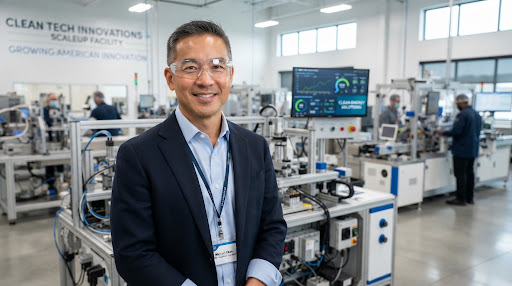
In this illustrative launch-edition case study, we follow IronPrairie Storage, a fictional Indianapolis scaleup, through the redesign that its founder, Marcus Sterling, says turned a stubborn supply problem into a competitive advantage. The company, its people and its figures are invented for the purpose of showing how a heartland hardware startup might scale. Every number below is described as company-reported within the scenario.
The story is a useful one because it is so ordinary. Grid batteries are not only about chemistry. They are also about boxes: the steel, plastic and fasteners that hold cells safely in place, keep water out, and let a crew bolt a container to a concrete pad in a farm field. When the box is late, the battery is late.
The problem: a casing that took 110 days
IronPrairie began, in this scenario, by buying pack casings from distant suppliers. The designs relied on specialty alloys and parts that arrived by ocean freight and then by rail. The company reports that lead time for a finished casing ran about 110 days from purchase order to dock door.
That delay rippled outward. Cells sat in storage waiting for housings. Cash was tied up in inventory. Rural electric cooperatives, which tend to plan projects around construction seasons, could not get firm delivery dates.
“We were not short of demand. We were short of boxes, and we had no way to promise a date to a co-op board.” — an operations lead at the company
The redesign: regional steel and local molding
The fix, as the company describes it, was to stop treating the casing as a purchased commodity and start treating it as a design problem. Engineers rebuilt the structure around standard structural steel sections that regional mills and fabricators already stock, and moved the non-structural pieces to injection-molded parts made by shops within driving distance of the Indianapolis plant.
Three design choices stand out:
- Common profiles. Using standard steel shapes means any of several fabricators can cut and weld a frame, so no single supplier is a choke point.
- Fewer unique parts. The company says it cut the part count sharply by letting one molded component do the work of several brackets and covers.
- Tolerant interfaces. Wider assembly tolerances let a local shop hit spec without exotic tooling.
The result, according to the company, is that casings now arrive about 72 hours after an order is released, down from roughly 110 days. Whatever the precise figure turns out to be under independent review, the direction is easy to understand: shorter supply chains mean shorter waits.
Unit economics, in plain terms
The company does not publish a cost per unit in this scenario, so we stay qualitative. Local steel and molding can carry a higher sticker price per kilogram than imported equivalents. The offsetting gains, the company argues, come from several places: far less inventory sitting idle, lower freight and handling, fewer expedited shipments, and fewer line stoppages.
For a scaleup, the biggest effect may be on working capital. When a casing takes days rather than months, a company can order closer to demand and keep less cash locked in parts. That matters for a business that recently closed a Series B round, which the company reports at $44 million. Investors in such rounds typically look for repeatable delivery as much as for a clever product.
Hiring in the heartland
The redesign also changed who the company hires. Instead of leaning heavily on procurement specialists managing overseas vendors, IronPrairie says it added welders, quality inspectors and manufacturing engineers who can work with nearby shops. Many of those roles do not require a four-year degree, and the company describes partnering with community college programs for training.
That fits a broader pattern across advanced manufacturing: demand for technicians who can read drawings, run inspection gauges and troubleshoot automated equipment tends to outpace supply. A scaleup that builds its own pipeline of such workers can grow without bidding for the same few specialists as everyone else.
Lessons for founders
The case suggests several takeaways that apply well beyond batteries:
- Design around what is nearby. If a part can be made from materials stocked within a day’s drive, delivery risk drops.
- Measure lead time, not just price. A cheaper part that arrives late can cost more than a pricier one that arrives on schedule.
- Keep two sources. Standard profiles let you qualify more than one fabricator.
- Tell customers a date. Rural cooperatives value a firm schedule; the company says its roughly 600 MWh delivered across four states came from winning that trust.
“Once we could say ‘three days’ and mean it, the sales conversation changed.” — a sales director at the company
Limits and open questions
Several things are not yet known or independently verified. The lead-time and delivery figures come from the company and have not been audited. Regional steel prices can swing, so the cost advantage may vary from year to year. Long-term durability of the new casings, including corrosion resistance and performance through many freeze-thaw cycles, can only be proven with time in the field. And a fabricator network that works at the current volume may strain if orders rise several-fold.
Readers should also remember that this is an illustrative scenario. It is meant to show a pattern, not to document a real firm.
What to watch next
If the model holds, watch for three signals: whether the company adds second and third fabricators without losing quality, whether delivery times stay short as volume grows, and whether field reports on enclosure durability match the design claims. Also watch whether other storage makers copy the approach. A supply chain built from nearby, standard materials is hard to disrupt, and it is a lesson any American hardware builder can borrow.
infoLaunch edition: this case study features a fictional company. Figures are attributed to the sources named in the text and have not been independently verified. Nothing here is investment, legal or financial advice. See our Editorial Standards and Corrections Policy.
Written by
Kareem Thorne
Manufacturing & Case Studies Editor. Newsroom staff in the launch edition are illustrative personas. About us • Report an error