Cold-Climate Automated Greenhouses: Snowline Greens' Zero-Natural-Gas Model
In this illustrative case study, a fictional Montana grower borrows waste heat from a neighboring data center and stores it in water, and reports that winter heating costs fell by about 88 percent.
Key takeaways
- check_circleCompany-reported: heating costs fell about 88% during -20F cold snaps after switching to recovered waste heat.
- check_circleWater thermal mass stores heat gathered from a neighboring data center for use overnight.
- check_circleThe savings are unaudited, and the model depends on a long-term heat supply agreement.
In this illustrative launch-edition case study, we look at Snowline Greens, a fictional Bozeman, Montana grower led by CEO Sarah Jenkins. The company, its people and its numbers are invented to explore a real question: can a greenhouse thrive through a Rocky Mountain winter without burning natural gas? Every figure below is described as company-reported within the scenario.
Winter growing is expensive almost everywhere cold weather reaches. A greenhouse is a big glass box, and in a deep freeze, heat leaks out as fast as it is pumped in. For many operators, fuel is among the largest line items on the budget. Snowline’s answer is to find heat that someone else was throwing away.
Where the heat comes from
Data centers turn nearly all the electricity they consume into heat. Operators spend money on fans, chillers and cooling towers to push that warmth out of the building. Snowline’s scenario places its greenhouse next to such a facility, so that warm air or water that would otherwise be rejected into the sky is instead piped across the fence.
This is called waste heat recovery. The temperatures involved are usually modest, often well below what a gas boiler produces, but a greenhouse does not need scorching heat. Vine crops such as tomatoes and cucumbers are comfortable at air temperatures most people would call a mild room. A low-grade heat source can therefore be a good match, especially when paired with efficient heat exchangers and in-floor or root-zone heating.
Water as a battery for warmth
The second piece is storage. The data center produces heat around the clock, but a greenhouse needs the most heat on the coldest nights. Snowline stores the surplus in large insulated tanks of water, a thermal mass that works much like a battery.
Water is well suited to the job. It holds a great deal of heat per unit of volume, it is cheap and non-toxic, and it can be charged and discharged thousands of times without wearing out. The basic cycle works like this:
- Charge. Recovered heat warms the tanks during the day, when crops need less.
- Hold. Insulation keeps the stored warmth from leaking away.
- Discharge. At night, pumps move warm water through pipes near the plants.
The company reports that, during cold snaps that dropped to around -20 degrees Fahrenheit, its heating costs fell by about 88 percent compared with a conventional gas-heated design of similar size. It also says the facility runs with no natural gas on site.
“The cold snap used to be the month we dreaded. Now the tanks do most of the work.” — a head grower at the facility
Automation and crops
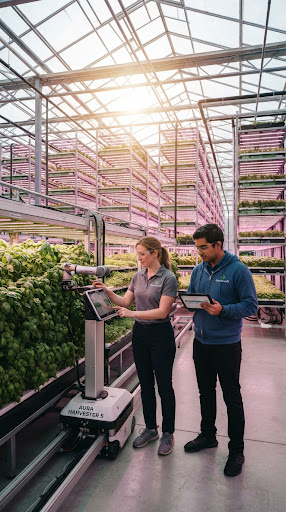
Snowline grows vine crops for Rocky Mountain grocers, with tomatoes and cucumbers as its core products. Automation ties the system together. Sensors track air temperature, humidity, light and tank temperature, and control software decides when to charge the tanks, when to draw from them and when to open vents. Automated carts and irrigation reduce the manual labor needed for routine tasks.
The company says a local supply chain is part of the appeal. Fresh produce that travels a short distance can reach shelves with more shelf life remaining, and grocers in mountain towns often pay close attention to winter supply, when much of the nation’s fresh produce arrives from far away.
Unit economics, qualitatively
The company does not disclose margins in this scenario, so we describe the economics only in general terms. Heating is a major operating cost for a cold-climate greenhouse, so reducing it can change the profile of the whole business. But there are offsetting costs: the tanks, piping, heat exchangers and controls require upfront capital, and the Series A funding, which the company reports at $19 million, helps pay for them.
Equally important is the cost of the recovered heat itself. If the data center gives it away, the savings are large. If it is sold under a contract, the price matters. Predictable pricing over many years is more valuable than a low price that can change. Electricity for pumps and lighting is still a significant expense.
Lessons for founders
The scenario offers several broadly useful ideas:
- Look for someone else’s waste. Heat, carbon dioxide and water are often thrown away by neighbors in industrial parks.
- Site selection is strategy. The best location may be the one with the best energy neighbor, not the cheapest land.
- Store, don’t just capture. Matching supply to demand in time is what makes a recovered resource useful.
- Write the agreement early. A clear, long-term contract with the heat provider protects both parties.
Limits and open questions
As with any scenario of this kind, important questions remain open. The 88 percent figure is company-reported and has not been independently verified, and the comparison baseline matters. A cold snap is one test; a full year of results, including cloudy spells and mild shoulder seasons, would give a fuller picture.
The model also depends on the neighboring facility. If the data center reduces its load, relocates or changes its cooling design, the heat supply could shrink. Data centers are also evolving, and some newer designs capture or reuse heat differently. Finally, whether the model works at many more sites is untested; not every greenhouse can find a willing industrial neighbor.
What to watch next
Look for year-round performance data, details of the heat supply agreement, and any second site. If Snowline, or a company like it, can show that waste heat plus water storage works in more than one location, the idea could spread to other cold regions where winter produce is costly and growers are searching for ways to lower fuel use.
infoLaunch edition: this case study features a fictional company. Figures are attributed to the sources named in the text and have not been independently verified. Nothing here is investment, legal or financial advice. See our Editorial Standards and Corrections Policy.
Written by
Kareem Thorne
Manufacturing & Case Studies Editor. Newsroom staff in the launch edition are illustrative personas. About us • Report an error